Navigating Disruption | Building Enduring Advantage
Adaptive Organisations
Strategy, transformation, and leadership insights on navigating a changing world
Leadership & Decision Making
Are you ready for a world of constant change?
26 practical tips for navigating change in an era where business transformation is the new normal
Strategy & Transformation
From Temporary Transformation to Continuous Improvement: are we seeing a paradigm shift?
A Kaizen culture, an interview with a practitioner, and the rise of a new adaptive organisation
Strategy & Transformation
How to Deliver a Successful Business Transformation
A practical four-stage guide, linking people, program, and outcomes
Strategy & Transformation
What Successful Transformations Get Right
Why leaders invest in both the rational and emotional sides of change
Leadership & Decision Making
Great Leaders Coach. Here Is How to Become One
A practical guide to leading transformations with greater confidence, stronger teams, and better results
Strategy & Transformation
Why the Future Organisation Will Look Fundamentally Different
Decision-making, AI, and the rise of distributed organisations
Strategy & Transformation
Can LEGO Benefit from GenAI?
How the LEGO Group bridges the physical-digital divide in its products, platforms, and experiences
Strategy & Transformation
How to go from Vision to Real Change in Three Steps
Avoid 6 months of stalled momentum in business transformation
Strategy & Transformation
How Can LEGO Integrate GenAI into its Ecosystem?
A practical view on where generative AI fits across products, platforms, and experiences
Strategy & Transformation
Three Steps CEOs Can Take to Turn Urgency into Real Change
How to avoid 6 months of stalled momentum using Kotter’s 8 steps model
Strategy & Transformation
Six Types of Organisational Transformation Every Leader Should Know
A practical view of transformation domains and their 48 initiatives
Strategy & Transformation
Two Frameworks to Identify the Drivers of Transformation
Recognise what's driving change and decode the archetypes of transformation
About
About the platform
Leadership is what enables strategy and transformation to work. Adaptive Organisations is a platform exploring how organisations navigate rapid disruption while delivering tangible value.The writing spans two inseparable areas:1. Strategy & Transformation — how organisations adapt their business models, operating structures, and capabilities in response to technological, market, and systemic change.2. Leadership & Decision-Making — how leaders think, decide, and navigate uncertainty, both within organisations and personally.The aim is simple: to decode how successful organisations and leaders adapt, perform, and endure.Follow for the latest updates.
About me
Hello, I'm Diana.I work at the intersection of strategy, sustainability, and transformation.Through Adaptive Organisations, I explore how leaders navigate disruption and build organisations that adapt, align, and perform in a changing environment.Let's start a conversation.

When Change Becomes Transformation
19th March 2026We live in an era of high uncertainty, rapid change, and increasing complexity.As such, organisations are facing a constant battle to stay competitive, valuable, and relevant.At the same time, the ability to adapt to new forces is a competitive advantage. Companies like Netflix and IBM have maintained their top positioning on the market by reinventing themselves while uncompromising on their identity.For instance, Netflix has undergone two major strategic shifts: from a DVD‑by‑mail rental service to a global streaming platform, and then to a streaming platform that also produces large‑scale original content. Throughout these shifts, it maintained a core focus on using data to personalise entertainment and on delivering a convenient, on‑demand viewing experience.However, incorporating agility by adapting and innovating without suffering from transformation fatigue and loss of identity, is easier said than done.So, what are the transformation drivers that leaders should look out for?
The Transformation Drivers Framework
Using the Ishikawa method, the MECE structuring approach, my experience as a strategy consultant and those of my senior colleagues who helped me cross-check it, as well as light use of AI to check for completeness of reasoning, I mapped 40 specific triggers across 8 domains (Exhibit 1):
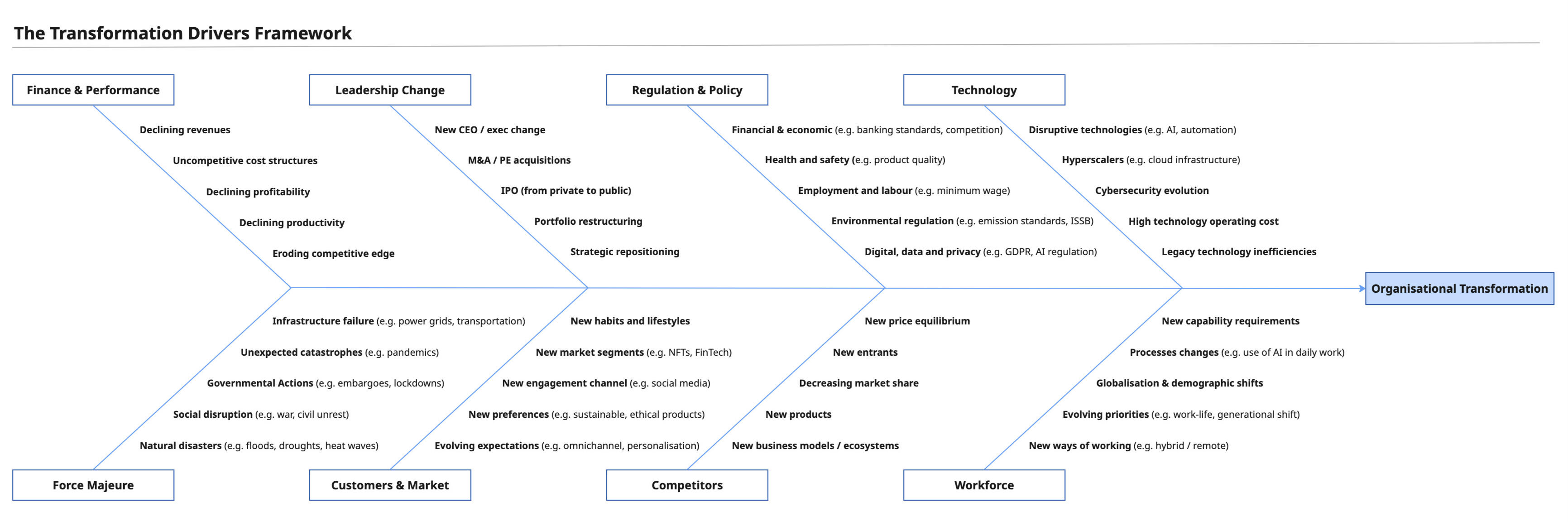
Exhibit 1: The Transformation Drivers Framework (by author)I would not claim this covers every single possible trigger, but it represents a significant portion of the key triggers. You will likely recognise some of the more familiar ones (highlighted in red), such as the impact of AI on the organisational ways of working, the challenges of sustainability reporting under frameworks like the ISSB, or the supply chains risks arising from conflicts, wars and embargoes, are just part of the story.Organisations use a more complex constellation of signals to decipher when and what to change.However, organisational transformations are rarely caused by just one trigger. A combination of 3–4 triggers simultaneously (such as technology disruption, customer expectations shift, new CEO strategy, and financial pressure) is necessary to create a transformation tipping point.Based on the insights from McKinsey & Company, Bain and Co, BCG, and the frameworks of Michael Porter, Clayton Christensen, strategic management frameworks, and PROSCI insights, we can begin to classify organisational transformations into a Four Transformation Archetypes.
The Four Transformation Archetypes
This model can help leaders answer the question: “Why is the organisation transforming?”Thus, triggers are categorised into the 4 most common archetypes of transformation tipping points (Exhibit 2):
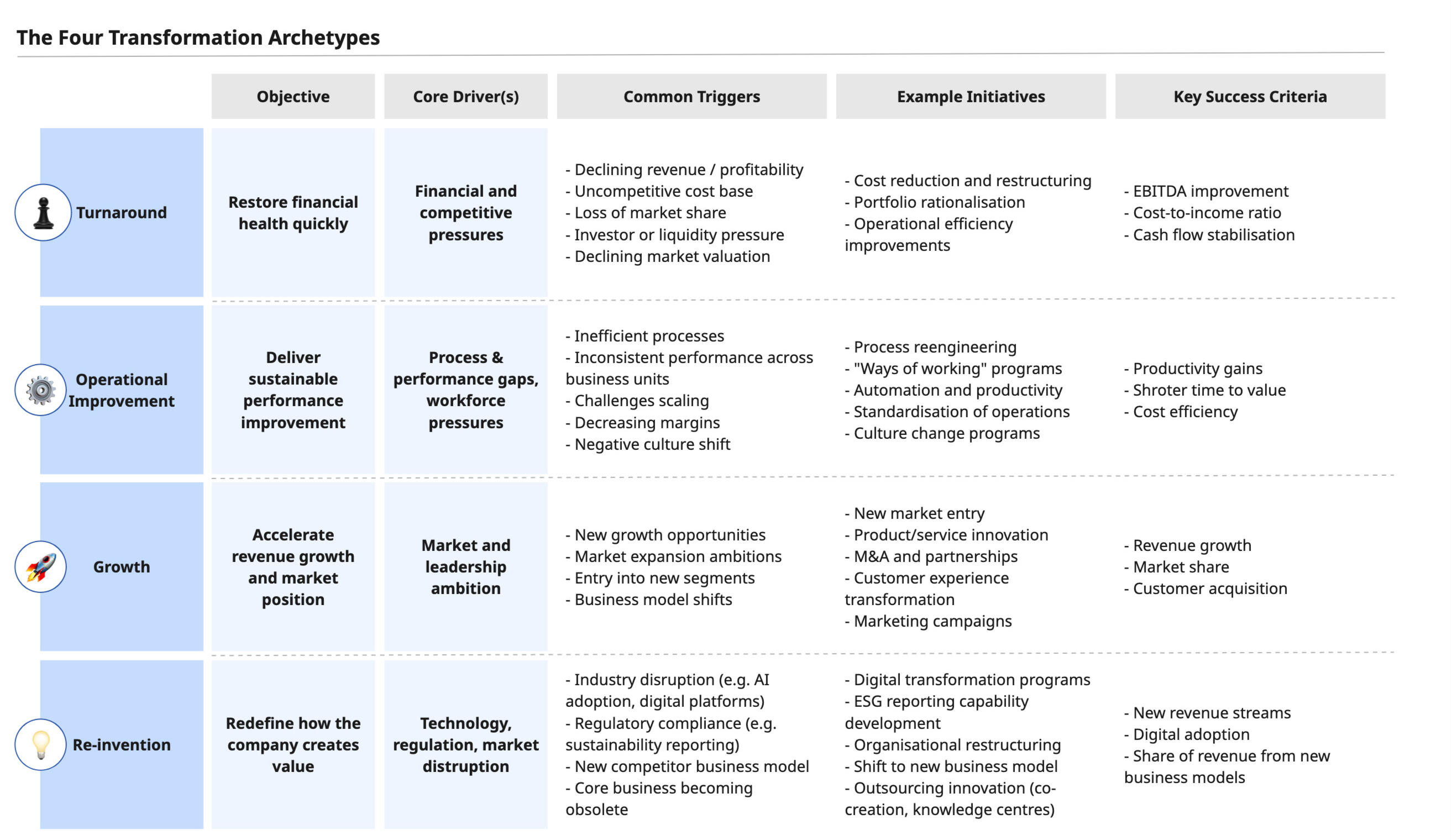
Exhibit 2: The Four Transformation Archetypes (by author)Note that this is a simplified model of transformation. Real transformations are multi-dimensional and have multiple nuances. (More about this model in Disclosures, at the end of the article)1st — Turnaround. Organisational transformation to Fix the Business is often triggered by financial and competitive pressures, such as low margins and decreasing productivity. The transformation is required to find a financial remedy fast and restore financial performance. Typical success criteria include KPIs that track financial health.2nd — Operational Improvement. Organisational transformation to Improve the Business is often triggered by gaps in performance, processes or workforce pressures, whereby the organisation is not operating at its full potential. Commonly, a transformation is required to improve the ways of working and close performance gaps to sustain competitiveness and meet business objectives.I have seen this challenge come up in some of my transformation work. For instance, a Telecom client was transforming their ways of working to improve time to market across borders while also aiming to reduce costs by around a third.3rd — Growth. Organisational transformation to Grow the Business is often triggered by the leadership ambition and market opportunities to expand either the product range, customer segments, geographical reach, improve product pricing, or all at once. This transformation is commonly characterised by new market entry campaigns, innovation and new product development, or new pricing strategies.I have seen this challenge in some of my work as well, such as during the long process of defining, founding and scaling a new corporate offering to meet the evolving client needs.4th — Reinvention. Organisational transformation to Reinvent the Business is often triggered by existential disruptions, such as technological advancements (e.g. AI), regulatory changes (e.g. sustainability mandates as a license to operate), or competitor or market disruption. Commonly, initiatives to address these shifts focus on moving the organisation to adapt to the new normal, such as investing in digital transformation, ESG reporting capabilities, and breaking silos in organisations for co-creation, alignment, and innovation.I have seen this challenge come up for a client as well, a global car manufacturer who was pursuing a core banking transformation to redesign the way they help their customers finance their car purchases.
Conclusion
The Transformation Drivers Framework and the Four Transformation Archetypes can help leaders understand:a) What is the root cause, and what triggers are they witnessing in their organisation?b) How close are they to a transformation tipping point?c) And if they are already transforming, what archetype is the closest match and what initiatives might help meet their objectives?This is a quick and general analysis of the organisational transformation triggers and archetypes agnostic of industry or geography. A targeted analysis with a clear end-goal for a specific program or organisation can reveal many more insights into “why” and “what” needs changing (if anything).Furthermore, as the coauthor of the book ‘The Secret of Culture Change’, Jay Barney, the author of the book ‘Good to Great’, Jim Collins, the PROSCI body of knowledge on organisational transformation, and many other authors have noted, organisational transformation is underpinned by a cultural transformation.Without the people enacting the change, no amount of planning will, by itself, move the needle.
If you found this article insightful, follow for more. I write on adaptive organisations, strategy, leadership, and decision-making in high-pressure environments.
Disclosure
Exhibit 1, The Transformation Drivers Framework, strives to capture a significant portion of potential triggers by using brainstorming, MECE structuring techniques, and professional experience from myself and peers. Even so, it is possible that there may be many more transformation triggers that are not yet captured in this diagram. If you think I’m missing some, let me know!Exhibit 2, the Four Archetypes Model, is a synthesis of recurring transformation patterns observed across strategy literature and consulting practice, grounded in sources: McKinsey and Company, Bain and Co, BCG, Michael Porter, Clayton Christensen, strategic management frameworks, Lean / Six Sigma body of knowledge, and the PROSCI change transformation methodology.This model simplifies a very complex domain of organisational transformation that inherently has multiple nuances and dimensions, with the goal of helping leadership frame the problem quickly and align stakeholders with greater ease.It has 5 inherent assumptions: 1) all transformations are goal-driven, 2) a dominant driver exists, 3) transformations cluster into repeatable patterns, and 4) business model disruption is categorically different, 5) internal and external triggers can be abstracted.The strengths of this model are that it syntheses real transformation archetypes observed in practice, aligns with multiple well-established frameworks, and provides a clear and easy method for leaders to diagnose and communicate change.Weaknesses of this model include the potential for some transformation cases to straddle the boundary between growth and re-invention, as well as the fact that this model provides only a generalised view that does not account for industry specifics.AI was used to check that the framework is MECE and accurate.
Six Types of Organisational Transformation Every Leader Should Know
A practical view of transformation domains and their 48 initiatives
2nd April 2026Organisational change is as much about understanding where you come from as it is about knowing where you are going.But most importantly, it comes down to knowing how to get there.My previous article explored the drivers of change and the archetypes of transformation, offering a structured lens to support clearer thinking and sharper conversations around how organisational transformation begins.This article builds on that foundation. It explores the directions of change, presenting a comprehensive view (Exhibit 1) of the most commonly observed types of organisational transformation and their associated initiatives.
THE FRAMEWORK — The Organisational Transformation Framework
The Organisational Transformation Framework outlines 6 dimensions of change and 48 associated initiatives.It is structured using the rigour of a logic tree, with branches that are mutually exclusive and collectively exhaustive (MECE), and is further informed by AI as a supporting layer to enhance depth and breadth of industry insight.
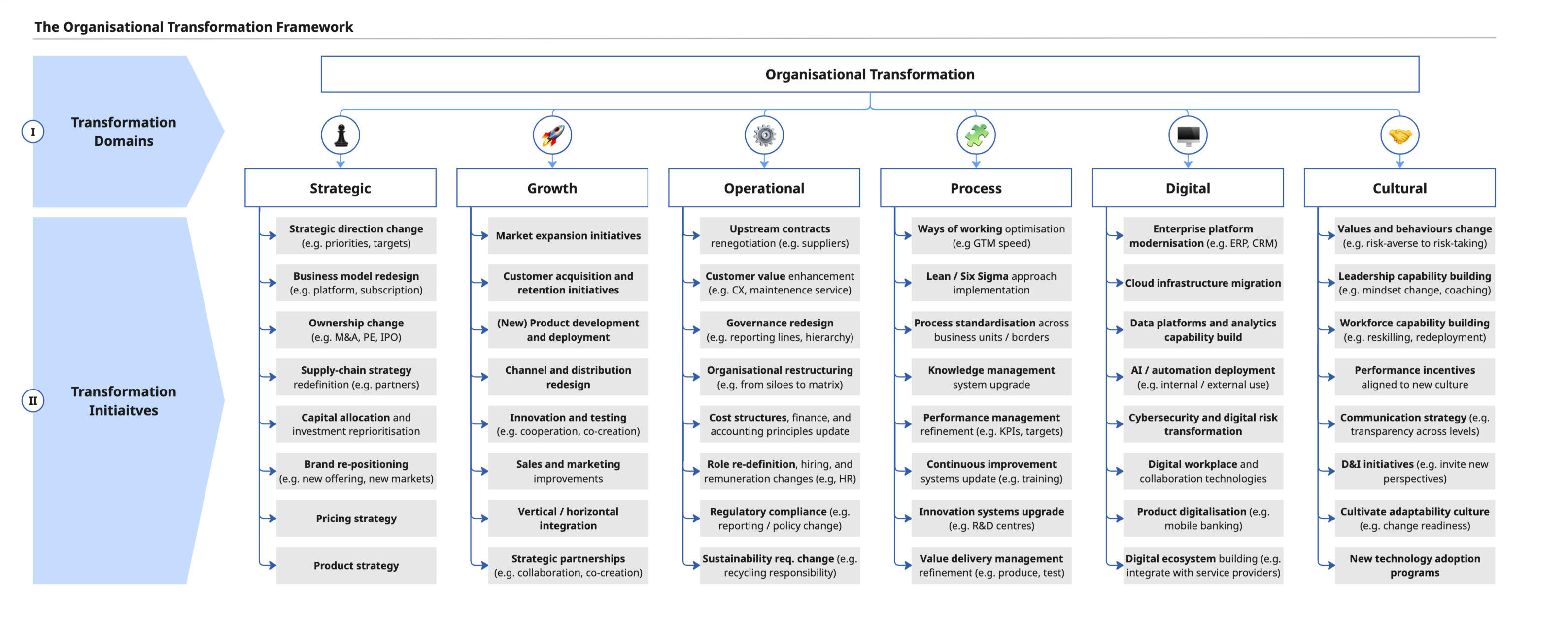
Exhibit 1: The Organisational Transformation Framework (by author)The challenge with mapping organisational transformation is the lack of a clear consensus on how it should be structured (in other words, what constitutes a single source of truth). Existing frameworks tend to structure transformation by impact, complexity, or the underlying drivers of change (PROSCI, HBS, IJECM).This framework employs a first-principles approach, offering a structure for organisational transformation based on the types of initiatives most commonly observed in practice.1st — Strategic TransformationInitiatives that redefine what the organisation does fall under strategic transformation, whereby the top management team defines the direction of travel and the objectives to be met.This includes initiatives such as redefining the business model or rethinking supply chain partnerships in response to environmental or geopolitical shifts. A well-known example is Netflix, which evolved from a DVD-by-mail rental service into a global streaming platform.2nd — Growth TransformationWhereas strategic transformation sets the direction, growth transformation focuses on execution.For example, where a strategic initiative defines a new ecosystem of partners in response to supply chain disruption, a growth initiative might involve vertical integration across suppliers. This can help increase control over the supply chain while improving operational efficiency and reducing costs.3rd — Operational TransformationThe way an organisation operates determines how agile and competitive it is on the market, as well as how quickly it can identify and respond to change. It also influences how successfully strategic and growth initiatives are executed.Jim Collins, in his book “From Good to Great”, provides a great example of how talent management shapes an organisation’s ability to navigate change. Before banking deregulation in the US, Wells Fargo, under the stewardship of Dick Cooley, rethought its approach to hiring and retaining talent to ensure it had the right capabilities to navigate future shifts.As a result, Wells Fargo outperformed its peers during deregulation, achieving returns three times higher, while its sector of the banking industry fell 59% behind the general market.4th — Process TransformationProcesses define how work flows and are effectively the organisation’s default operating system. They are often executed automatically, without intentional direction, which can either work in the benefit or to the detriment of strategic goals. Initiatives aimed at improving processes focus on how the organisation operates “under the hood,” enabling greater speed and efficiency.For example, one client I worked with was pursuing an initiative to standardise ways of working across seven business units in different geographies, with the aim of reducing time to market and lowering costs. Such initiatives not only benefit the organisation but also its customers, who ultimately gain from more reliable broadband services at home and abroad.5th — Digital TransformationIn recent years, digital transformation has become almost synonymous with organisational transformation, as the current rate of technological change has been consistently faster than the rate at which organisations can adapt to it.Digital initiatives can improve operational efficiency (such as through automation, AI-enabled workflows, or enhanced cybersecurity), as well as create customer value (for example, by offering digital products such as mobile banking, bridging the physical–digital divide, or enabling on-demand services).6th — Cultural TransformationPeople are at the centre of any organisational transformation, a point echoed by PROSCI, as well as firms and authors involved in transformation work (such as McKinsey & Company and Jay Barney).Much of the heavy lifting often lands on the shoulders of leaders, who are responsible not just for driving change but also for modelling it. This includes understanding how to move individuals from resistance to acceptance and ultimately to thriving in a new environment.For example, the impact of culture on company success is conveyed by Jim Collins. When faced with competition from Procter & Gamble (P&G) in the paper-based consumer business in the 1960s, two incumbent companies in the same industry with similar financials, Scott Paper and Kimberly-Clark, responded differently.Whilst Scott Paper “resigned itself to second place”, Kimberly-Clark saw this competition as an asset. Under Darwin Smith’s leadership, the team fostered a culture of continuous improvement and a winning attitude, framing this challenge as an opportunity to make the company greater.Despite operating in the same environment, different cultures and different leadership led to diverging outcomes. Under Darwin Smith’s stewardship, Kimberly-Clark generated cumulative stock returns of 4.1 times the general market, owned Scott Paper, and outperformed P&G in 6 of 8 product categories.
PURPOSE
In practice, transformation efforts are often discussed in fragmented terms (whether digital, operational, or cultural) without a clear view of how they connect. For example, departments may pursue their own transformation initiatives, with varying degrees of coordination with other departments or alignment with a unified corporate direction.This framework is intended to bring these transformation elements into a single, coherent view. It is not designed to be exhaustive, but rather to offer a practical lens that can be applied across different transformation contexts. As with most frameworks, its value lies in how it is applied, adapted, and challenged in practice.It aims to provide a clearer view of transformation scope, help locate where initiatives sit, and support alignment across complex programmes.
APPLICATION
The framework is designed to be a practical tool that can be used to:
Frame transformation scope at the outset
Map existing initiatives across domains
Identify gaps or overlaps
Support leadership discussions on priorities
It is worth noting that it is not intended to be a replacement for detailed programme design, rather a way to bring structure and coherence to complex transformation efforts.
CONCLUSION
Transformation is often complex and systematic, requiring coordination across the entire organisation to make it a success. It is rare for organisations to pursue just one type of transformation at any given moment, which is why it is crucial to have an eagle’s eye view of every single initiative and where they fit.This framework can make it easier to understand exactly this. Namely, what is changing, why it is changing, and how the different elements connect.
If you have been involved in transformation efforts, what do you think?Does this structure reflect how transformation plays out in practice?What would you add, challenge, or refine?If you found this article insightful, follow for more. I write on adaptive organisations, strategy, leadership, and decision-making in high-pressure environments.
How to go from Vision to Real Change in Three Steps
Avoid 6 Months of Stalled Momentum in Business Transformation16th April 2026The CEO declares: “We must change or perish!”They create emotional urgency, imbue employees with a sense of action, and make change feel inevitable.Six months later? Business as usual.What went wrong?This challenge might sound familiar.Creating urgency is just the beginning of organisational transformation. What happens after defines whether change becomes a reality that endures or a message that fades.I found it useful to draw on both my experience and John Kotter’s 8-step model to understand where change breaks down and what can be done to fix it.With 6 months gone and business confidence falling, there is no time to waste.
THE FRAMEWORK — Kotter’s 8 Steps Model
John Kotter’s 8 Steps for Leading Change incorporates key lessons from decades of observing organisational transformations, capturing the common success criteria into 8 steps.When a CEO creates a burning platform, they declare an existential crisis where the cost of inaction is greater than the cost of change. This is just the beginning, namely step 1 of 8.However, most transformations break down between steps 2 and 4, long before anyone sees visible change.Here is a high-level summary of steps 2 to 4 of Kotter’s model:Step 1 — Create urgency. Done, but there is a catch: There is a difference between fear-based urgency (“we are dying”) and opportunity-based urgency (“this is what’s possible”). Fear can paralyse people rather than mobilise them. It is worth asking: “Did people believe the platform was truly burning, or did they think the CEO’s speech was only dramatic?”Step 2 — Build a guiding coalition. This is often a failure point. A CEO cannot drive transformation alone. If no senior cross-functional group was formed and empowered to lead the change, the urgency had nowhere to land. Middle managers, the real transmission layer of any organisation, never got activated.Step 3 — Form a strategic vision. Urgency without direction is just anxiety. If the CEO says why things must change but not what the future looks like, people freeze. “We must change” is not a vision. “This is what we are becoming and why it is worth it” is.Step 4 — Communicate the vision. Even with a vision, if it was communicated once (town hall, all-hands email) and never reinforced, it evaporated. Kotter says leaders under-communicate vision by a factor of 10. One speech is not a communication strategy.Steps 5 to 8 (removing obstacles, generating short-term wins, sustaining acceleration, instituting change) often do not get a chance to operate if 2 to 4 are broken.
APPLICATION
The model helps us gain a clearer picture of where challenges normally arise in the first few months of implementing change, as well as what questions we should be asking to uncover potential inefficiencies.Now that we have a rough idea of where to look, we can go back to our case where the CEO created a burning platform, and check whether any one of these challenges is present in their change programme.A good diagnostic conversation usually involves these questions:1. “Who else, besides you, was responsible for leading this change?”If the CEO hesitates, names no one, or says “my HR director was coordinating it”, it is highly likely that change broke down at step 2. No guiding coalition means that the leadership team did not act on the urgency for change.In contrast, if the CEO has a solid coalition in place, it is already a good start. However, they may still have blind spots. They may have a coalition, but how empowered or committed is the coalition truly? Are those people leading the change, or coordinating it?2. “What were you trying to get people to move towards?”How a CEO answers this question tells you as much as what they answer.A compelling vision should be articulated in under 60 seconds. It should be emotionally resonant and specific enough that employees can make decisions against it on a daily basis. If the CEO has a strong answer, then vision clarity is likely not the challenge.However, if the CEO takes three minutes, uses abstract jargon, or describes a process rather than a destination (“we are implementing an agile transformation”), this already reveals a potential challenge. If this is the case, then a lack of vision clarity is what prevents change from happening.3. “How often was change communicated? And by whom?”An effective communication strategy takes everyone on the journey towards the desired state, creates engagement throughout the organisation, and tailors change as an opportunity for growth for everyone involved.In contrast, if there is no clear communication strategy, if it is fragmented or confusing, and different people tell you different things about what the direction is, this is likely the cause of stalled change.4. “What would you have done differently?”This reframes challenges into lessons learned, thus inviting collaboration, candour, and constructive analysis of what went wrong with a focus on how to fix it. It is essential for the CEO and leadership to take a pragmatic and thorough introspection to drive change in the right direction.Caveat: this can be a sensitive topic, especially if the question is framed more bluntly like “What challenges do you face?” A question that requires leaders to locate failures within themselves or their decisions can lead to defensiveness, since it triggers reputation protection.Emotional intelligence matters just as much as a factual approach.
RECOMMENDATION
There is a real risk of designing the perfect system while momentum bleeds out. Not to mention constraints like resources, politics, and time, which rarely let you do everything at once.For a CEO who has lost six months and organisational confidence, regaining momentum through small, rapid wins might be a priority.In comparison, for a CEO who wants to enter an innovation-driven market, the priority might be to design an accurate plan to shift the organisational culture from risk-averse to risk-taking in a structured way.Therefore, there is considerable nuance when recommending a change approach. The recommendation depends on a variety of factors, including:
Does the CEO have a clear understanding of what the opportunity is?
What has been the company’s history of change? What attitudes do they have towards change?
If a change programme is underway, where has it broken down?
What is the priority for the next 30 days? Is it quick wins, regaining momentum after six months of stalling, or is it creating a coalition?
What kind of change is being implemented? What are the core levers driving that change (cultural shift, digital transformation, market expansion)?
It is worth noting that there is also the cost-of-wrong-direction.I have seen this play out in real life, where it is more costly to drive in the wrong direction and then try to adjust course, than to take thirty days upfront to choose a good direction and then drive at full speed.Thirty days of planning might feel slow. But six months of misaligned effort, which is what happened to the theorised CEO, is far more expensive.Having said that, if I were to prioritise 3 steps that leaders should take to turn urgency into real change, I would recommend the following:
1st — Clarify the future state.
When leaders create a burning platform, they must also be clear on what the opportunity is behind that urgency and be pragmatic about what it would take to get the entire company there. This brings vision clarity (step 3) right to the forefront.This sequencing may be unconventional, since it is hard to enact change without political buy-in, but it has its strengths. Having vision clarity sets the North Star for the organisation, the culture, and the coalition that they should aim towards.Jim Collins argues that good-to-great companies first get the right people on the bus, the wrong people off the bus, and the right people in the right seats, before they decide on a direction.However, in my experience, I found that when you are making that choice about people, you already have a rough vision of the purpose of that bus. That rough vision is what guides your selection process. Next is to get the people who can challenge, shape and sharpen your vision and devise a path to get there.
2nd – Build the informal communication
To make change real, create stories to build momentum and shift behaviour. The way information flows through the company is twofold:a) formal (forums, announcements, all-hands meetings, emails)b) informal (coffee chats, stories, culture, behaviours).Informal communication shapes what people see as acceptable behaviour, guides decision-making at all levels, and is what kicks in when there are no formal rules governing certain situations.The organisation that wants to change needs to master both.Firstly, they need to create stories that support the future state. For example, say a CEO of a siloed organisation wants to make it more collaborative. One way to do this through informal communication channels is for them to act to actively break silos.This one action becomes a story that travels through the organisations. Three of these actions create a narrative, and the organisation starts to see that breaking silos is the new normal. This is how culture shifts. (Jay Barney explores this topic further here)Only after these stories are circulating does the CEO need to launch an official communication strategy to strengthen this narrative of change.The key is to keep both channels of communication pointing in the right direction. Once one of them eases, momentum drops, and the urge to revert to the old ways becomes stronger.
3rd – Embed accountability
On top of establishing a guiding coalition with a clear directive, it helps to establish a mechanism by which you hold this coalition accountable for implementing the change.Consistent with a portfolio management approach, this includes defining key deliverables, setting milestones, following roadmaps, and establishing alignment meetings to track and measure progress and surface any obstacles.This drives real results and ensures plans are acted upon with consistency and deliberation.
REALITY CHECK
This sequence of vision → stories → coalition works well when the CEO has genuine credibility, and the organisation still has trust in leadership.It works less well in low-trust environments, where people have seen big visions announced before with little follow-up. In those contexts, the story must come before the vision. Leadership must make visible, unexpected actions that signal “this time is different”; otherwise, the vision announcement is not acted upon.This is sometimes called the credibility gap problem, namely, the bigger the past failures, the more emphasis needs to be placed on behaviour compared to communication.
CLOSING THOUGHT
Every transformation is unique. Different leaders will have different challenges that require different solutions. The deeper we dig, the more complex this becomes.There is, however, one certainty.To turn urgency into real change, leaders must balance between:
– Confronting the brutal facts (the burning platform)
– Maintaining a strong vision for how they will prevail (the change programmes)
If you found this article insightful, follow for more. I write on adaptive organisations, strategy, leadership, and decision-making in high-pressure environments.
DISCLOSURE
AI has only been used as a sparring partner to run the simulation and challenge assumptions and recommendations.
Can LEGO Benefit from GenAI?
How the LEGO Group bridges the physical-digital divide in its products, platforms, and experiences30th April 2026Digital transformation is as much about adopting new technologies as it is about aligning them with your brand identity and customer value.LEGO has the physical “brick” at its core. It engages both children and adults in creating tangible builds, inviting them away from the digital world and into the physical.So how can a superbrand that’s become synonymous with physical play navigate the age of AI, where experiences are increasingly virtual?
STEP 1 — Framing the opportunity
LEGO has already integrated digital technology into its value proposition. From expanding into digital platforms like LEGO Ideas, to producing LEGO Fortnite, releasing LEGO movies, and introducing the Smart Play System that bridges the physical–digital divide.Implementing GenAI features will require a careful balance between innovation and identity.This is not just a question of “How do we build GenAI?”, but rather: “How can this technology reinforce the LEGO values most at risk, namely imagination and creativity?”Deconstructing this challenge into a MECE structure (Exhibit 1), here is one way to frame the opportunity LEGO faces:
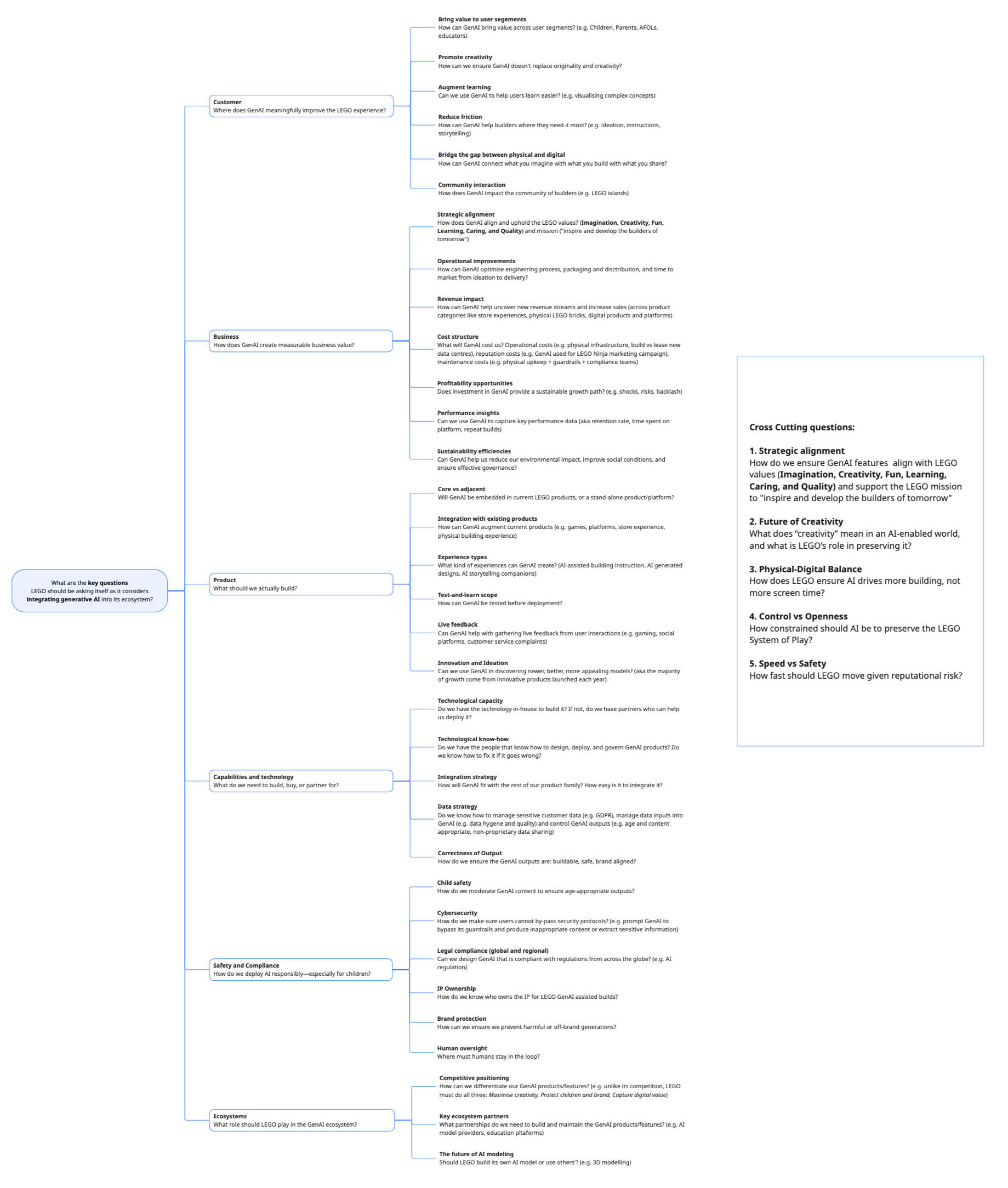
Exhibit 1: Key Questions for LEGO when integrating GenAI (by author)That’s a busy diagram. Precisely the point: applying AI within an established global brand, especially one rooted in the physical world, is inherently complex.Let’s break it down.LEGO operates across six dimensions affected by AI, prioritised below along with their key considerations:
1st — Customer
How does GenAI meaningfully improve the customer experience?This sits at the core of LEGO’s value proposition: deepening engagement with builders, enhancing creativity, and bridging physical and digital play.Key questions include:- How do we define creativity in the age of AI?
- Who owns the intellectual property of AI-assisted creations?
- How do we ensure children continue to think independently and creatively when equipped with such powerful tools?The answers form the foundation of the brand itself.
2nd – Business
How can GenAI create measurable business value?Once customer value is clear, the next challenge is operationalising it. This opens opportunities to enhance efficiency and generate deeper insight into customer preferences and unmet needs.Key questions include:- How can GenAI drive both operational efficiency and strategic advantage?
- What are the financial and sustainability implications of deploying AI?
- Where can we build and sustain competitive advantage?Positioning the business to capture this value becomes the second building block of LEGO’s digital transformation.
3rd – Product
What should we actually build?With customer needs defined and business alignment established, the focus shifts to product.Key considerations:- How will GenAI-powered features integrate with the existing portfolio?
- How do they reinforce core values (creativity, learning, and social interaction)?
- Can GenAI accelerate the design of new builds and experiences?This is where strategy translates into tangible outcomes. This is where ideas become products that drive both brand and business value.
4th – Capabilities and Technology
What do we need to build, buy, or partner for?This is the execution layer. If earlier steps define the “what” and “why,” this defines the “how.” In other words, now that we have designed the blueprint of the car we want to build and defined its purpose — how do we actually build it?Key considerations:- Do we have the required capabilities in-house?
- Which partnerships are critical to delivery?
- What feedback loops and controls are in place to identify issues early?Clarity here determines both feasibility and speed to market.
5th – Safety and Compliance
How do we deploy AI responsibly, especially for children?Say we built the car. But is it safe to drive?LEGO serves not only adults but also children, raising the bar for responsibility.Key considerations:- Do GenAI products meet safety, ethical, and regulatory standards?
- How do we ensure age-appropriate, brand-aligned outputs?
- Where must human oversight remain in place?This dimension anchors innovation firmly within the brand’s values.
6th – Ecosystems
What role should LEGO play in the AI ecosystem?Now that we have created the mechanism for building the car and have deployed it to our users, what does that say about us? This is a fundamental question about how LEGO shapes, and is being shaped by, the evolving AI landscape.Key considerations:- How will GenAI offerings compete over time?
- Which partnerships are essential for long-term relevance?
- How can capabilities (3D modelling with AI) extend into adjacent industries such as manufacturing or the built environment?This is where LEGO defines its role on GenAI not just through products, but through the relationships it forms, and the capabilities it contributes.
STEP 2 — GenAI Products and Features
Questions are useful to frame the problem, but they must lead to tangible outcomes.Building on what LEGO has already achieved, here are the GenAI products and features that are likely within reach (Exhibit 2):
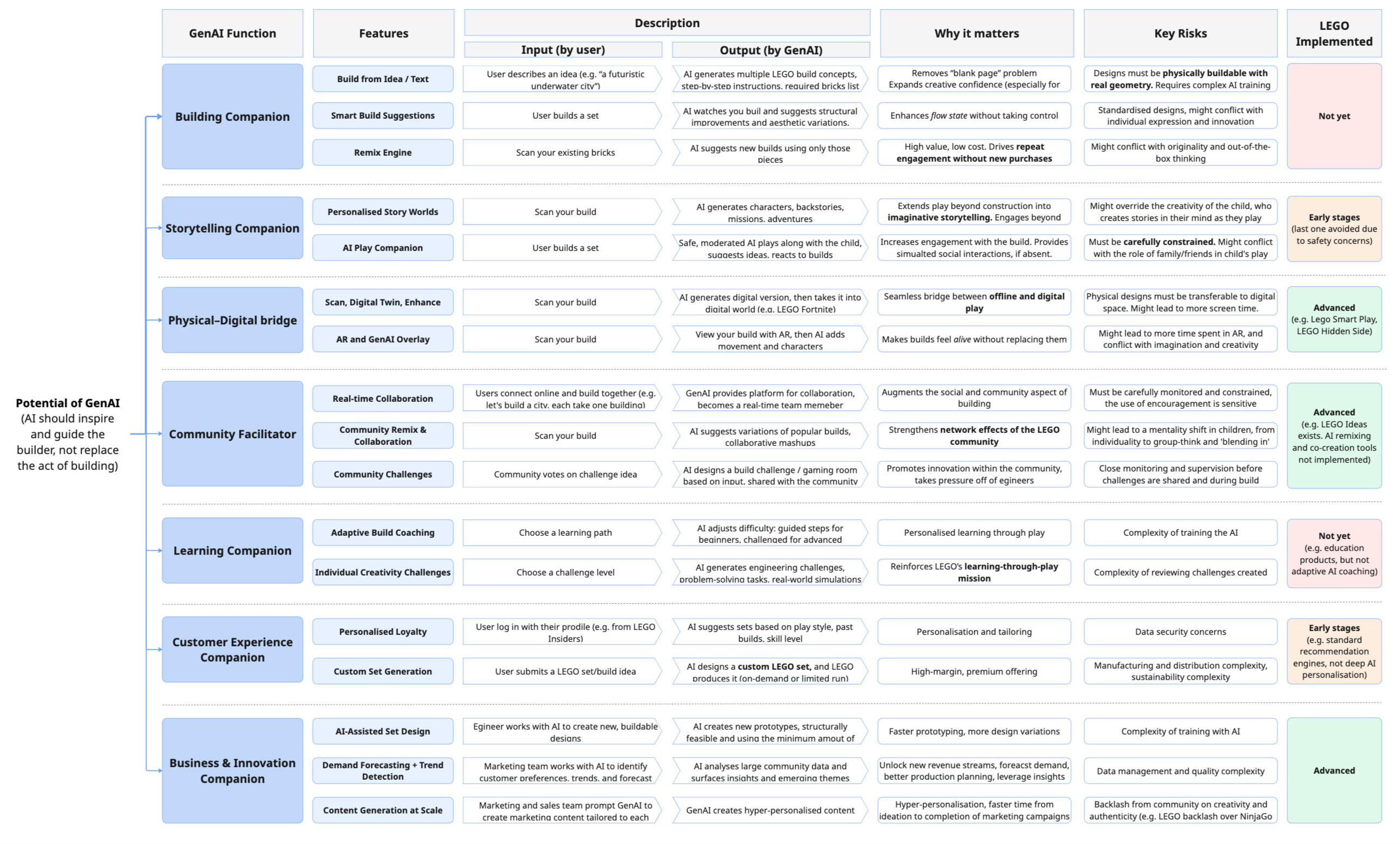
Exhibit 2: Potential GenAI Agents and Features for LEGO (by author)Again, that's a complex diagram. And rightly so. Even with LEGO's constraints, there is a wealth of possibilities for AI innovation. But each opportunity carries risk and requires deliberate controls.Here's what's possible.In the age of AI agents, it is useful to frame innovation around the roles these agents can play. First, define the role. Then, identify the features that enable it:
i. AI as a Building Companion
Imagine you want to build an underwater castle but have limited bricks and no clear starting point.An AI companion could analyse your available bricks, generate a buildable design, identify missing pieces, and provide step-by-step instructions tailored to your skill level.This addresses the “blank page” problem, supports creative flow without taking over, and optimises the use of existing bricks without new purchases. LEGO has already taken steps in this direction with LEGO Builder, which offers digital 3D instructions.The core challenge lies in ensuring that AI-generated designs are physically buildable within LEGO geometry, which requires highly specialised training. The risk: over-reliance on AI could unintentionally constrain creativity and imagination. Hence, such features should be handled carefully.LEGO is in the early stages of developing these features, based on what is known to the public, and herein lies an opportunity for future development.
ii. AI as a Storytelling Companion
Consider what happens after a build is complete. You spent half a day building a castle for your princess and her knight. Now what?With an AI storytelling companion, play can continue beyond construction. Using Augmented Reality (AR) or Virtual Reality (VR), children could scan their creations and unlock dynamic narratives, such as stories, characters, and adventures layered onto the physical build. This is what LEGO Hidden Side introduced in 2019–2020.The biggest risk, however, is that it might increase screen time for children as well as hinder creative thinking when children create their own stories in their minds as they play. Such stories are essential for out-of-the-box thinking and originality when growing up.LEGO is in the early stages of developing this category of features based on what is publicly known. What’s more, the AI playing companion has been stopped in development because of privacy and safety concerns.
iii. AI as a Physical-Digital Bridge
The previous example bridges the Physical-Digital gap by adding virtual stories to the physical build.This a long-standing ambition. LEGO launched the LEGO Smart Play System in March 2026, introducing “smart bricks” that respond with sound and light in response to how children play with them. The common criticism of this technology is that children are already quite adept at making realistic sounds and special effects as they play.Another way AI can bridge this gap is by enabling you to take what you have built into your video game (e.g. LEGO Fortnite). For example, say you have built a robot in the physical world. Theoretically, you could then scan the robot and tell the AI agent to transfer it into your LEGO Fortnite video game adventure for you to interact with it digitally.The biggest challenge here is translating physical geometry into the digital world and then gamifying it on the spot. This requires extensive AI processing. It also leads to the risk of increased screen time.LEGO is already advanced on this front, as evidenced by products like LEGO Smart Play System, released in March 2026 and the LEGO Hidden Side, active between 2019 and 2020, where users scanned their builds to reveal a digital world of ghosts and could be solved by manipulating the physical bricks.
iv. AI as a Community Facilitator
Imagine building a shared world with your friends and family across different locations. Platforms like LEGO Builder and LEGO Play already enable collaborative creation. AI could extend this by acting as a facilitator, offering prompts, suggesting improvements, and supporting group dynamics.However, this introduces questions around privacy, data security, and autonomy. There is also a risk of over-facilitation, where AI dampens genuine human interaction.LEGO is already advanced on this front, as evidenced by platforms like LEGO Ideas where users can submit their design ideas or vote for their favourite build for a chance for that build to become a real product.
v. AI as a Learning Companion
AI could personalise learning journeys for builders of all levels.Beginners might receive structured progression paths, while advanced users could be challenged with increasingly complex builds tailored to their interests (e.g. Architecture, Star Wars, Botanicals).The difficulty lies in scaling personalisation across millions of users, which requires deep insight into preferences, behaviour, and even existing brick inventories so that AI can recommend builds based on the bricks they have.While LEGO has invested heavily in educational products, such as LEGO Education, to foster STEAM skills, fully adaptive AI coaching remains an emerging capability.
vi. AI as a Customer Experience Companion
Internally, AI agents can help teams better understand their customers.By analysing purchasing patterns, store analytics, digital interactions, and engagement data, AI can surface insights into customer needs, pain points, and opportunities for value creation.The challenge is to avoid shallow generalisations, labelling, and categorisation of users. True value comes from extracting nuanced insights, such as context, intent, and underlying drivers, not just trends.This remains an area of active development for LEGO.
vii. AI as a Business and Innovation Companion
GenAI can also augment other departments.Designers could use 3D modelling with AI to generate and iterate on new designs, while business teams could leverage it to identify trends, forecast demand, and shape strategy.The technical hurdle remains significant: generating designs that adhere to LEGO geometry and physical constraints is far from trivial. Nonetheless, experimentation (e.g. text-to-build tools) is already underway, such as LegoGPT or BrickItApp.This is one of LEGO’s strongest positions, particularly given its potential spillover into adjacent industries like construction and manufacturing.
REALITY CHECK
LEGO must balance GenAI innovation with its core values.Unlike its competitors, LEGO must pursue all three simultaneously:- Capture digital value
- Maximise creativity
- Protect children and brandShort term: Customer experience is the most immediate opportunity. Applying AI to better understand users and personalise offerings can unlock near-term value.Medium term: AI-driven storytelling offers a compelling avenue, provided content quality and brand alignment are tightly controlled.Long term: Building and learning companions represent the most transformative potential. However, they also carry the greatest technical and ethical complexity.Ultimately, the decision rests with LEGO. The path forward depends on a variety of factors, including which features they prioritise, the capabilities they have in-house, and the strength of external partnerships.
CLOSING THOUGHT
The evolving ethical, privacy, and regulatory landscape around GenAI makes transformations like this inherently challenging.It is inspiring to see LEGO, a global brand whose beating heart is the physical experience, innovate extensively in the digital space without losing sight of its core values.Much of the foundation is already in place - hardware (e.g. Smart Play), platforms (e.g. Ideas), and digital experiences (e.g. Fortnite). The next step is to build the intelligence layer that connects these elements into a cohesive ecosystem.
If you found this article insightful, follow for more. I write on adaptive organisations, strategy, leadership, and decision-making in high-pressure environments.
DISCLOSURE
This is an independent, outside-in analysis based on publicly available information. The views are my own.
The Future Organisation Will Look Fundamentally Different
14th May 2026
How does transformation actually move through an organisation?Once the CEO declares a crisis and the mandate for transformation is set, how does this change trickle down through the organisation?What are the:- Decision centres
- Organisational layers
- Information flows
- Systems and processes
- Behaviours… that need to be activated for this transformation to produce the desired outcome?
Similarly, what is holding these transformations back?In the last two decades, only “12% of transformations create sustainable performance gains, even after three years,” according to Jana Werner and Phil De-Brun ( article here).Before we see how transformation flows through an organisation, we need to understand how the organisation is structured and how leadership makes decisions when they need to change.For this reason, let’s think from first principles:- How is an organisation structured?
- How does it make decisions?
- What is it optimised for?
THE DIAGRAM - The Evolution of Organisational Structures
The three common (although simplified) organisational structures include:1. The Traditional Pyramid Organisation
2. The Start-up Organisation
3. The Octopus OrganisationThese structures are the result of the environment they operated in:1. The traditional pyramid organisation is optimised for the industrial age, where scale, control, and predictability were the keys to success.
2. The start-up organisation is optimised for the internet age, where speed and mobility are the keys to success.
3. The octopus organisation, a new metaphor to encompass more agile systems and structures, is optimised for the AI and complexity age where adaptability to sudden and significant changes is the key to success.This evolution is captured in the diagram below (Exhibit 1).
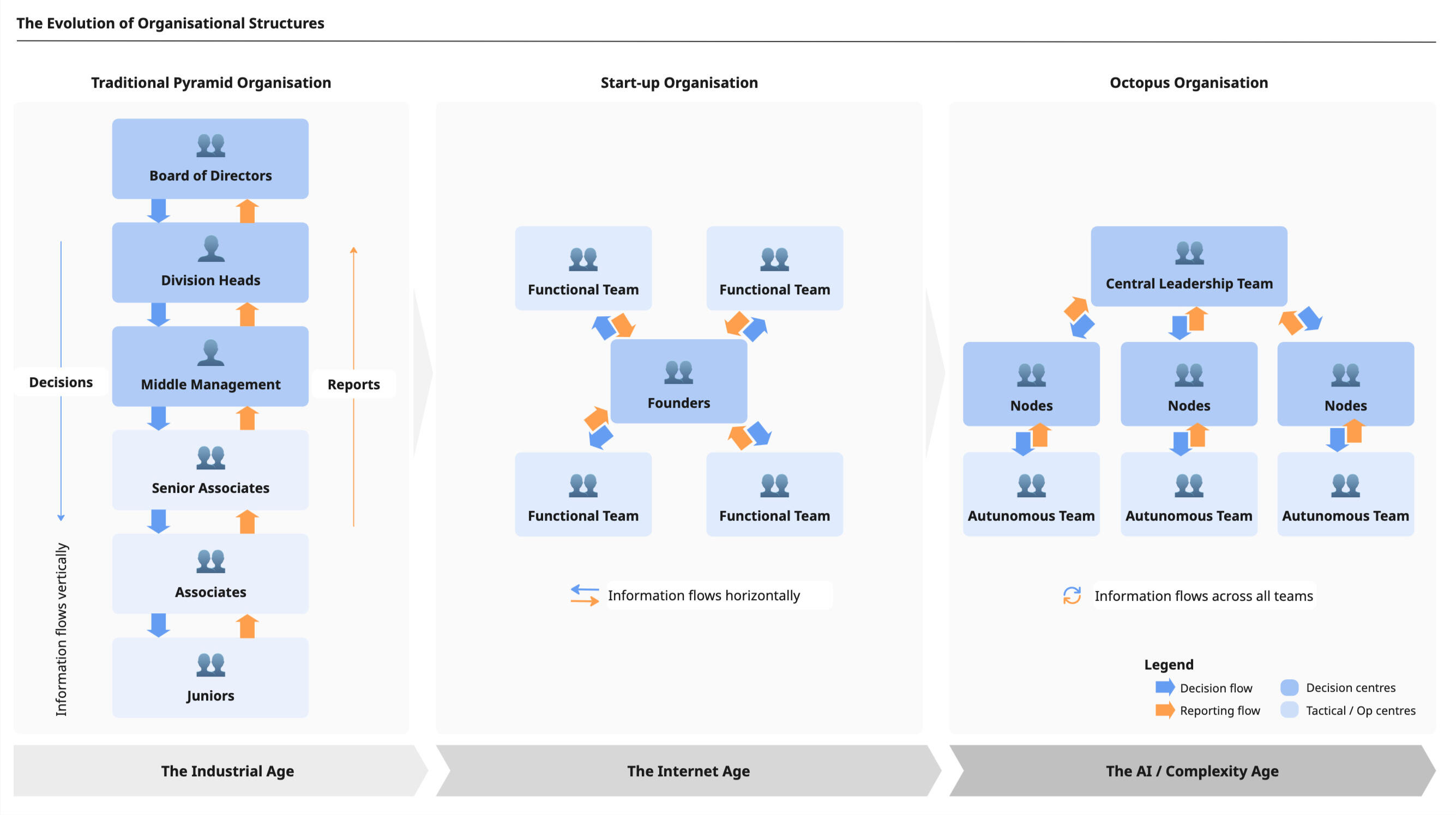
Let’s break this down:1. The Traditional Pyramid OrganisationThis structure is perhaps the first that comes to mind whenever we talk about transformation efforts.The Board of Directors decides that it is time to change, and that mandate is ordered across the organisation and trickles down through the division heads, middle management, and finally to the front line.Information flows vertically. Decisions commonly flow top-down, and the recipients must produce the results assigned to them and report up the hierarchy.The people making the decisions do so within their field of influence. The decision centres are often the top management team, division heads, and middle managers, also called the strategic and tactical layers. The execution occurs at the operational layer, which often rests with senior associates, associates, and juniors. (This McKinsey article has more)This command-and-control approach is optimised for a world where disruption is minimal and episodic, challenges are predictable, and the solutions are clear.However, it struggles when challenged by rapid change, high uncertainty, and complexity, where it needs to make decisions fast, adapt to emerging trends, and draw on the knowledge of its people across the hierarchy. It requires cross-functional coordination faster than the hierarchy allows.
This is where another type of organisational structure challenges this rigid structure.2. The Start-up OrganisationFounders conceptualise a product or service, gather a team to help build and deploy it, and disrupt established players in their own industries.This organisational structure is often a flat hierarchy where information flows horizontally between small, functional teams and the founders. The founders are the decision centres, who adjust course as new information comes in. This structure is optimised for fast responses to new trends, but often struggles to scale.A common example is the rise of FinTech as a disruptor of the banking industry. Whereas traditionally, the brick-and-mortar banks controlled the entire value chain, from payments to insurance to mortgages and loans, FinTechs focused on one link in that chain and innovated with speed and rigour. Think of digital wallets (Apple Pay), peer-to-peer payment apps (PayPal), and roboadvisors (Betterment). Start-ups are fast, nimble and specialised to respond to the market and the customer as they change.The banks’ response was to either buy out their competitors to access that centre of innovation, collaborate with such FinTechs or tech companies, or develop competitive products in-house.With time, even the FinTech industry was challenged by tech companies, who brought with them the highest standards for user experience, mobile-centred products and services, and products optimised for accessibility and aesthetics. A key development in the FinTech industry was the emergence of super-apps and digital-native banks like Revolut. (But this topic needs a whole new article.)
The biggest challenge the start-ups face is growing without compromising adaptability or adopting a rigid traditional structure. The best of both structures is what has been recently introduced as the “Octopus Organisation.”3. The Octopus OrganisationThis concept is introduced by Jana Werner and Phil Le-Brun in their book and discussed further in their article and podcast with HBR.This structure is named after the octopus, which has nine brains: one central brain for processing information, and eight mini-brains for each of its arms for autonomous function.The structure follows this analogy. An octopus organisation is thus a distributed system, where intelligence and decision-making are spread across the company.- A central team scans the horizon, coaches the leaders across the organisation, and sets the strategic priorities based on information coming from all sides of the organisation and their environment. They provide direction, alignment, and guardrails.
- Meanwhile, autonomous teams closest to the customers or the market sense changes and act with autonomy and flexibility to adapt to the information they are receiving.However, it doesn’t end there. According to the authors, an Octopus Organisation has to adopt this identity to the very tips of its arms. Namely, they must enable innovation, experimentation, and ownership at all levels of the organisation, from the front-line workers to the leaders.When people have the autonomy to own their area – whether that be a Starbucks barista serving customers, a manager of a convenience store optimising sales per customer, or an expert in charge of developing new AI-enabled products – they can produce outstanding results. Guided by a clear company mission (e.g. becoming the place between work and home, being the go-to store for customer needs, or improving the lives of people through innovation), these teams can respond to change much more effectively.In the age of AI, adaptability is the name of the game. The organisations best suited to navigate this age of complexity and AI are the ones where information flows freely, people can make decisions autonomously, and innovation spreads because it works and not because it’s force-fitted.
CLOSING THOUGHT
Transformation is the effort by organisations to become better suited to a new reality.It is not a finite project whose mission is to change bits and pieces of an old system, like changing the parts of a jet engine. Rather, it is a journey to redesign the jet engine entirely.Transformation is the journey of evolving from an outdated organisational structure to a new one. It implies adopting new models that rethink outdated structures, systems, and behaviours and becoming better equipped for the new reality.
If you found this article insightful, follow for more. I write on adaptive organisations, strategy, leadership, and decision-making in high-pressure environments.
Great Leaders Coach. Here is How to Become One
30th May 2026Leaders are not always trained to be coaches. Yet this skill is essential when leading people through today’s rapid changes.“The leading causes of failure are employee resistance and management behaviours that do not support the desired change” (Blackburn et al, 2011; BMT)Business transformation is where it matters most. Successful transformations need more than setting targets, tracking progress, following roadmaps, and communicating the change. New tools, new processes, and new systems all need people to change.Coaching is how great leaders close that gap between surface-level commitment and true engagement. The key is understanding the deeper layers of people’s identity, how they perceive change, respond to it, and the impact it has on their development (Joseph Grech has more in his article on ICF). This unlocks insights into how you can create space for people to contribute to and belong to the new state you are creating.Luckily, this can be learned. Here are two categories of tips:1. Immediate tips — things you can apply in your next conversation
2. Long-term tips — deeper capabilities to strengthen your leadership over timeBut before we dive in, the sceptics in the room might be asking: “Does coaching actually provide tangible results?”Funny you should ask. Let’s look at the data.
Does coaching provide tangible business results?
The short answer? Yes. Here’s why.
Case Study 1: MD AndersonThe success story of MD Anderson is one case of many where the coaching culture delivers tangible improvements in business performance, according to Stephanie Norris in her article on ICF.In this case study, Stephanie Norris gives an account of the University of Texas MD Anderson Cancer Centre, an institution on a mission to end cancer for patients and their families. MD Anderson launched an enterprise-wide ICF-accredited coaching programme to boost employee engagement and reduce turnover. The preliminary results were promising. An internal survey in 2023 reported the following achievements:- 25% lower turnover compared to the control group
- 19% higher promotion rates compared to their control counterparts
- 32% higher favourability in teamwork in 2023 than in 2017
- 32% higher team collaboration in 2023 than in 2017
- 38% higher employee engagement in leadership in 2023 than in 2017This success story shows that coaching can not only improve employee retention, productivity and efficiency, but also enable an organisation to be more agile in the face of change by training leaders to continuously learn and adapt.Case Study 2: AEON VietnamAEON Vietnam, the leading retailer in Vietnam, established a coaching culture on the belief that “leaders create leaders,” according to the account by Robert Garcia in his article on ICF.As a result of its coaching programme, AEON Vietnam achieved:- 12% higher team performance in 2023 than in 2021
- 7% higher coaching recipient satisfaction score in 2023 than in 2022
- 115% higher workforce happiness than the average score of the retail industry in Vietnam in 2023Furthermore, other accolades include:- Consistently ranked in the 100 Best Companies to Work for in Vietnam
- Ranked the top company to work for in retail by Anphabe
- “Lower turnover rates than the average rate in the retail industry”
- “Surpassed projected sales budgets since the implementation of the program”
- Earned the ICF Coaching Impact AwardAEON Vietnam is using the coaching programme to create a coaching culture where employees are empowered and encouraged to ask questions, try new things, and take ownership. This paves the way for greater innovation, collaboration, and engagement at the enterprise level.Case Study 3: Applications across professional services firmsNotably, companies that operate across borders delivering consulting services must gain and retain a high level of trust with their clients in any region and any domain, as emphasised by Magdalena Nowicka Mook in her article on ICF.Which is why adopting a coaching culture is a must for many of these companies to ensure their employees deliver the highest standards of service:- EY provides professional development opportunities across the organisation, including support for individuals’ milestones (from promotion to parenthood). “89% of (leaders) who had experienced coaching saw their leadership brands improve”.
- Deloitte’s coaching culture emphasises well-being and relationships, providing one-on-one executive coaching to managers, senior managers, and top leadership. According to internal surveys, “the executive coaching program is one of the most beneficial and impactful opportunities Deloitte offers”.
- PwC supports individuals in learning coaching skills and strategies in their Coaching Academy, as a result of their strong belief in the benefits of coaching.These examples of a coaching culture in global, profitable, client-centric companies emphasise the idea that coaching is a key driver for navigating change whilst delivering strong business performance.
Immediate tips — start applying today
Whilst mastery requires dedication and time, here are quick steps you can take right now to strengthen your leadership style:1. Separate your role as an expert from your role as a coachMcKinsey’s research on radical transformation describes how leaders must now show up as multiple archetypes, including coaches who can build new organisational capabilities and inspire others to learn fearlessly.The tension most leaders feel is that they are also the subject-matter expert in the room. The discipline is knowing when to switch modes:- When the team needs your expertise, give it
- When they need to develop their own capability, coach themMaking that distinction explicit builds trust on both sides.2. Ask more, speak lessManagers have the tendency to tell their team what to do, preserving the control-and-command approach for a hierarchical organisation.Leaders who coach support their employees, recognising that a front-line worker might know more about the problem they are facing and how to solve it. (Octopus Organisation, previous article)
In your next conversation, ask the right questions for your team to discover the answers by themselves.This has benefits:
- Promotes greater autonomy, ownership, and creativity in solving the problem at hand
- Helps employees make their own decisions
- Actively develops their skills on the job.In practice, this means replacing statements with questions. Before you share your solution, ask the person what they think the problem is and what options they see.Research from HBR found that the skill managers struggled with the most was “letting the coachee arrive at their own solution.” Naming this tendency is the first step to correcting it.3. Leave space for people to answerAsking the right questions is great. Tolerating the silence that follows and holding the space for people to open up slowly and gradually is the next level.Powerful, open-ended questions prompt people to think deeply and reflect. Active listening then enabled you to understand their underlying concerns and emotions. This kind of deep engagement enables a meaningful response.In transformation contexts, where people are anxious and resistant, the quality of your questions signals respect. Practically, swap closed questions (“Did you do this?”) for open ones (“What’s getting in the way of this?”). Resist the urge to fill the silence. The pause is where the thinking happens.For more on this topic, check: ICF Core Competencies | Joseph Grech’s article on ICF.4. Create psychological safetyCoaching is about creating a safe, open space where employees feel comfortable thinking through their challenges. Balance curiosity with empathy.This is as simple as rewording “Why didn’t you handle this sooner?” to “What got in the way of addressing this earlier?” The difference in that phrasing is the difference between a conversation that shuts down and one that opens up.During a transformation, people are already on edge. Your language either builds or erodes the trust that makes change possible.For more on this topic, check: “How to use the GROW Model for Coaching Employees”5. Adopt the GROW model in conversationsThe GROW model (Goal, Reality, Options, and Way Forward) is one of the most widely used coaching frameworks in leadership, performance development, and organisational transformation.It provides a simple yet powerful structure for guiding meaningful conversations, enabling participants to quickly discover:- What is the goal?
- What are the obstacles?
- What are the options?
- How do we move forward?This model is action-biased, meaning that challenges and changes must always have a clear definition and an action to address or bypass them. You can use it in a ten-minute check-in or a deep one-on-one.6. Close every coaching conversation with a clear commitment.The ultimate goal of coaching is to turn new insights into action. This means partnering with people to design actionable goals, integrate new learnings, and build accountability systems.At the end of every one-on-one or team discussion, ask: “What are you committing to, and by when?” This is the natural completion of a coaching conversation, and it drives the behaviour change that transformations depend on.
Long-term tips — skills that take time to master
To become a great leader, practice and discipline are essential. Here are some of the directions worth developing:1. Develop genuine self-awarenessThe competency that surprises people most is not active listening or powerful questioning. It is presence.Self-awareness is the foundation beneath presence. It has two dimensions: understanding your own emotions, triggers, and biases, and understanding how others experience you. Both take sustained effort. Useful practices include journaling, peer feedback, and working with your own coach.Leadership coaching develops self-awareness and can help leaders uncover hidden behaviours, beliefs, and motivations that affect their leadership style.For more, check: “The 8 ICF Core Competencies” | “Self-Aware Leadership”2. Develop your emotional intelligenceResearch consistently shows EQ to be among the most powerful predictors of leadership effectiveness.Leaders who master empathy perform 40% higher in engaging others, coaching, and decision-making. Gallup’s 2025 State of the Global Workplace report confirms that 70% of team engagement is attributable to the manager. Engaged teams consistently show lower turnover, higher productivity, and stronger customer outcomes.EQ is a set of competencies (self-awareness, self-regulation, empathy, and social skills) that can be trained through coaching, reflection, and deliberate practice over time.3. Internalise a coaching mindsetCoaching is a partnership that empowers the coachee to find their own answers. The coach’s role is to create a safe space for exploration, reflection, and growth.Leaders who perform the techniques without internalising this belief tend to use coaching as a sophisticated form of telling. The mindset shift, truly believing your people hold much of the answer, takes time and usually requires being coached yourself.Hybrid environments, rapid technological change, and shifting employee expectations have elevated the need for leaders who can connect authentically. That kind of connection cannot be fabricated.4. Build a coaching cultureBy embedding coaching skills across leadership levels, organisations can build lasting change capability, accelerate adoption, and create more resilient, humane, and effective change practices.This is a multi-year organisational effort. McKinsey’s research shows that organisations in the top 25% for management practices have 21x higher average returns than those in the bottom. Coaching culture is a core driver of what separates those tiers.The ICF’s 2025 Annual Report highlights Microsoft’s MCAPS division, which expanded coaching to over 70,000 employees and saw stronger engagement, clearer career direction, and increased internal mobility as a result.5. Pursue formal coaching trainingFor leaders serious about making coaching a durable capability, industry-leading companies offer consistent standards for coaching and a clear framework to measure capability, identify areas for improvement, and advance coaching skills.At the organisational level, companies offer internal ICF-accredited coaching programs like the ones mentioned in MD Anderson, AEON Vietnam, EY, Deloitte, PwC and others. These coaching initiatives integrate coaching directly into the flow of work, accelerating business impact and strengthening long-term performance.This integration is a great way to develop coaching skills, and also where the most durable transformations take root.
CLOSING THOUGHT
There are two interdependent trends here.The leadership style trend (from directing to coaching) is tied to the organisational structure trend (from hierarchical to distributed, as mentioned previously).The organisational structure trend involves moving from a hierarchical to a distributed structure (aka an Octopus Organisation). In the latter structure, decision-making and innovation are distributed across the entire organisation, making the organisation more agile to sudden changes and better equipped to navigate the age of complexity and AI.The leadership style trend involves moving from directing to coaching. This leadership style amplifies the characteristics of a distributed organisational structure. Leaders who coach recognise that their teams have a better understanding of the problem and its solutions, and need the right level of autonomy to act fast when things change abruptly.If the distributed organisation is an octopus, the coaching leadership style is the blood that gives it agility.
If you found this article insightful, follow for more. I write on adaptive organisations, strategy, leadership, and decision-making in high-pressure environments.
DISCLOSURE
AI was only used to gather information from a variety of high-quality, high-authority sources (ICF, HBR, McKinsey and others).
What Successful Transformations Get Right
Why you should invest in both the rational and emotional sides of change11th June 2026Organisations are 2.6 times more likely to achieve success in transformations if they address both the rational and the emotional aspects of change (EY).When leaders make a change, from implementing new ways of working, adopting new technology, or expanding their teams through mergers or joint ventures, the success of that transformation comes down to:- Have we achieved our objectives in time?
- How well are we doing in this new state, from a business and people perspective?
- Is this new state sustainable? If we step away now, will our people keep it up?For every person in the organisation who is either part of a transformation or directly impacted by it, their routines and comfort zones are likely to change. Human factors and emotions are the root causes of transformation failure across industries and geographies, according to research. They're also the key drivers of successful transformation.Leaders have a duty to create discipline and structure, but also to be empathetic and courageous to bring everyone with them in the new system. They have a duty to create the conditions for success at both the rational and the emotional level.
THE TWO SIDES OF TRANSFORMATION
Transformations are more likely to succeed when they have the executive support and change champions that infuse teams with the energy to change and the accountability to do it right.Organisational structures can vary, but taking a high-level approach, we can be categorised into the three management layers:
Strategic Layer — consisting of the top executive team responsible for setting the vision, charting the course, and creating urgency for change
Tactical Layer — consisting of the managers and heads of practice responsible for devising the processes and approaches that will make that vision a reality
Operational Layer — consisting of associates and front-line workers responsible for implementing and adopting these approaches
If we assume transformation starts with the strategic layer and moves down the hierarchy, then we can map specific actions to each layer that should be taken if a transformation is to succeed.Yet this view alone is missing something important. Namely, the emotional side of transformation is the responsibility of everyone in the organisation and cannot be assigned to just one group or management layer. Exhibit 1 can help us visualise the actions that need to be taken at the rational and emotional level.
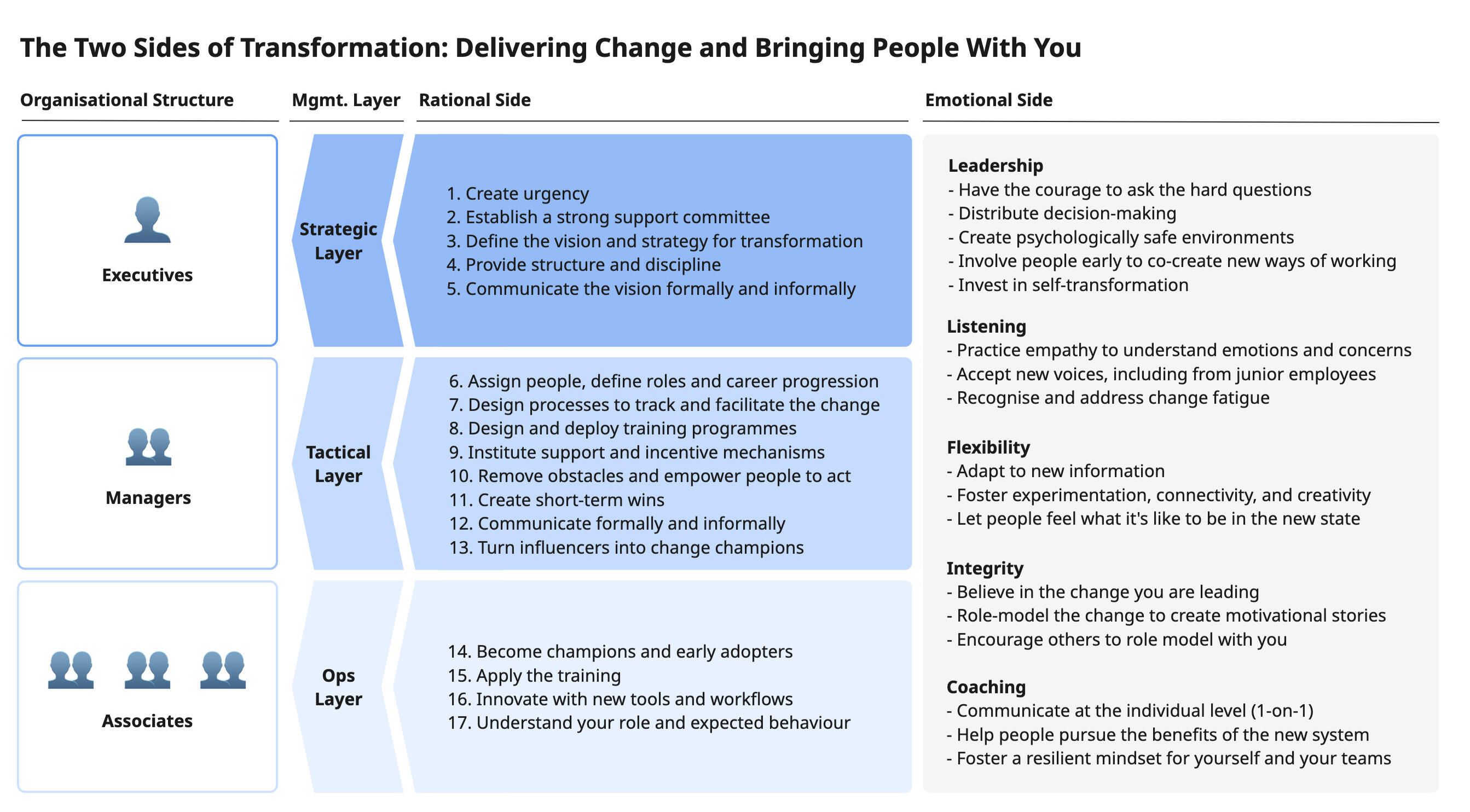
Exhibit 1: The Two Sides of Transformation (by author)
The Rational Side of Transformation
The rational side is akin to a skeleton. It consists of all the plans, processes, tools and partnerships that an organisation needs to structure and keep the transformation effort on track.This diagram maps the industry best practices to the management layer that would be directly responsible for the outcome and have the means and influence to achieve it. The 17 rational actions are only a selection, and I’m sure you can think of many more.Strategic actions:1. Create urgency — make sure the organisation understands why change is necessary and what will happen if the status quo is preserved. The purpose is to “make the status quo seem more dangerous than launching into the unknown”. The urgency is high enough when 75% of leadership is convinced that staying with the status quo is unacceptable (Kotter).2. Establish a strong support committee — although the impulse to change may start with one person, you need to build a coalition for change to be effected throughout the entire organisation. A powerful coalition does not necessarily include every senior exec, but it consists of members who have a strong commitment to change and the ability to influence it throughout the organisation (influence, expertise, relationships, etc.)(Kotter).3. Define the vision and strategy for transformation — creating a vision that is clear, compelling, and inspires people to go the extra mile is the centre of the transformation upon which everyone will start building (Kotter, EY).4. Provide structure and discipline — transformation is no longer linear. It is complex and can become messy. (EY) At the same time, transformation is becoming a modus operandi, a continuous muscle that needs to be trained and used whenever new changes come up. Leaders must provide a structure that is stable enough to frame that transformation effort, and flexible enough to allow for variations and changes of course along the way.5. Communicate the vision formally and informally — leaders under-communicate the vision by a factor of 10 (Kotter). It is essential to create and communicate a change story that is clear and inspirational, which lets stakeholders know why change is necessary, what is changing, and what the new state is (McKinsey Influence Model). It is not enough to communicate it once, but consistent messaging through every channel of communication available is key (PwC).Tactical actions:6. Assign people, define roles and career progression — in successful transformations, employees reported they had clear roles and responsibilities, taking away the confusion and anxiety and instituting a clear sense of mission and how to execute it. This is essential for addressing negative emotions that invariably come up during transformations. (EY)7. Design processes to track and facilitate the change — for transformations to work, leaders should introduce new rituals and routines to reinforce desired behaviours that make up an organisation’s culture (McKinsey). Furthermore, find a way to make sure that the people assigned to enacting the change are delivering what was promised. This can take the form of progress tracking, community meetings, or consistent check-ins to see the state of transformation efforts and surface any blockers or dependencies. My other article explores this further.8. Define and deploy training programmes — help people acquire the skills that they need to be productive in the new state (McKinsey Influence Model)9. Institute support and incentive mechanisms — establish ways to reward people for adopting the desired tools or behaviour, such as through remuneration, recognition, giving them ownership of certain outcomes, and setting certain targets together (McKinsey Influence Model). At the same time, provide the support they need, whether that is guidance, mindset shifts, inspiration, community, or emotional support.10. Remove obstacles and empower people to act — people want to help bring about the change, but they might encounter blockers. Sometimes they are mental blockers, like limiting beliefs, but very often they are actual obstacles, such as inflexible processes, rigid organisational structures, or legacy systems. Not every blocker can be easily removed, but the big ones should be addressed (Kotter).11. Create short-term wins — whenever you introduce something new, people will be sceptical at first. Which is why you need to create small wins, build the momentum, and promote your progress. That’s when people start to get on board. I have seen this work in my own leadership experience, and it is something promoted by Kotter as well.12. Communicate formally and informally — one of the challenges transformations face is disaggregated messaging from leadership. One leader communicates a vision, the other communicates a different one. Aligning on the vision and on how it is communicated is key.13. Turn influencers into change champions — find the informal leaders whom everyone comes to for advice, who everyone listens to when they speak up, maybe even seen as “rebels”, and get them on your side. Train and protect them, let them help each other, and unify them in small groups with a clear purpose. With their support, you can build momentum and reach people’s hearts via informal communication. (McKinsey, PwC, EY)Operational actions:14. Become champions and early adopters — as an associate, become an early adopter, a role model who builds momentum for the transformation from the start and works together with leadership to achieve their objectives. Take an active change champion role to own and define a part of what is changing.15. Apply the training — as an associate, engage with the training materials to learn the new skills necessary to thrive in the new state and actively seek to use your transferable skills in new ways.16. Innovate with new tools and workflows — as an associate, become curious about how the new state works and adopt a learning mindset to find new ways to apply it in your own work to bring positive outcomes. This should be done within the constraints of the organisation’s tolerance for experimentation.17. Understand your role and expected behaviour — as an associate, actively seek to understand what the desired behaviour is that you need to adopt for the new state, and act upon it. Understand your new role in the new system and define your career progression together with the managers shaping it.Now for the hard part — bringing people on the journey. It is one thing to create a perfect plan, another to implement it, and a complete challenge to convince people to change.Yet that is what you need to do for the transformation to be successful.
The Emotional Side of Transformation
While the rational best practices can be neatly mapped to the organisational structure, the emotional side is different.The emotional side applies to everyone, from the associates whose careers have just started to the senior execs who are seeking support for the change they are leading.The selection of 17 best practices to address the emotional side of change can be broadly categorised into 5 groups of overarching skills:Leadership
Have the courage to ask the hard questions — questions that encourage people to challenge proposed plans, resolve long-held tensions to enable productive conversations, review performance that separates the action from the person, and deliver feedback timely and constructively are the 4 main types of courage in leadership (McKinsey Quarterly). In transformations, these questions ensure leaders discover early warning signs and steer their teams with compassion and clarity.
Distribute decision-making — essential in the face of constant transformation, sudden change, AI and complexity. This is the idea that front-line workers closest to the problems often have the solutions, and they need the autonomy to solve them fast when change happens suddenly (Octopus Organisation). Transformation has a common goal, yet change leaders should also have the power to correct course in their own areas of influence if they see their teams are not adopting change as well as they could. The freedom to execute is key to successful transformations (EY).
Create psychologically safe environments — studies have shown that investing in the 6 aspects of employee wellbeing (economic security, mindsets and beliefs, productivity activity, sleep, social interaction, and stress) provides significant benefits for long-term success (McKinsey OHI). Creating psychologically safe environments gives people the confidence to voice their concerns and ask for help without the fear of consequences. This is essential when understanding whether the transformation works as it should.
Involve people early to co-create new ways of working — in some cases, people might feel that change is happening to them, rather than for or with them (McKinsey). In successful transformations, leaders engage people from the start and define the new state and the new patterns of delegation, ownership, and empowerment with them (EY).
Invest in self-transformation — leaders are the top drivers of transformation, but they are also under the most pressure. They need to manage up (produce results), manage down (inspire change), and manage themselves (address fears, anxieties, and self-doubt about the journey ahead). Which is why it is critical for leaders to a) recognise their limitations, and b) take action to mitigate them (adopting resilient mindsets) (EY).
Listening
Practice empathy to understand emotions and concerns — change takes people out of their comfort zones, and that creates emotional resistance. Being willing and able to listen and understand people’s emotional triggers can help you motivate them from the heart (PwC).
Accept new voices, including from junior employees — acknowledge that you don’t have all the answers and create opportunities and environments for people to speak up and come forth with ideas for improvement (PwC). For an organisation going on AI adoption and learning to survive in a world of complexity and constant change, it is essential to enable information to flow across the levels of the hierarchy (HBR on the Octopus Organisation).
Recognise and address change fatigue — The average employee now experiences ten planned change programmes per year, 5 times more than a decade ago (HBR). According to Gartner, 73% of HR leaders say their employees experience change fatigue, and 74% of managers are unequipped to lead it. Starting new transformation programmes while the workforce is experiencing change fatigue and negative feelings is a serious risk (EY).
Flexibility
Adapt to new information — the future that you have planned for might be completely different to the future you arrive in in 3 years. Which is why leaders should constantly check if their vision for change is still on course to achieve the objectives set out in the beginning, or if changes need to be made to correct course.
Foster experimentation, connectivity, and creativity — nobody has been in the new state before, which is why people need to experiment to know what works and what doesn’t. This is the natural path of learning. Accept it and make space for it. Shift the mindset from “don’t fail” to “fail fast”. Small failures can lead to big successes, in the words of EY.
Let people feel what it’s like to be in the new state — it might be difficult for people to imagine what the new state will look like when short-term deadlines are taking up all their time. Leaders need to create stories that inspire. This helps people understand the “why” behind the “what” needs to change (McKinsey’s Influence Model) as well as helps them see themselves as part of that new change (McKinsey). Let people try out new tools or new workflows that you want to adopt, let them see what it might be like to use them every day, and this shows them what it is that they are striving for (PwC).
Integrity
Believe in the change you are leading — going from an understanding of the vision for change to a true belief in it is like going from mechanically pressing the piano keys to imbuing your playing with heartfelt passion. People can tell when a leader believes what they are saying or is just repeating a script. They are more likely to trust and follow the person who believes it will work, and believe it themselves.
Role-model the change to create motivational stories — transformations are 5.3 times more likely to succeed when leaders role-model the desired behaviour (McKinsey Quarterly). Action speaks louder than words. The need for transformation is only felt when people see everyone around them adopting the new behaviours, which is when they start taking action too (McKinsey Influence Model). Furthermore, when a leader takes an action that is boldly different from the old ways of working and in line with the new state, that action is so unexpected that it creates stories in organisations. These stories spread, and soon people start believing and start adopting a similar behaviour to the story (Jay Barney).
Encourage others to role model with you — not everyone will buy into the change you are leading, so they might agree with you verbally but change nothing in their behaviour or area of influence. If this behaviour goes unaddressed, people start losing trust in leadership, momentum stalls, and scepticism spreads. Making sure that people embody the change is essential for successful transformations. (HBR)
Coaching
Communicate at the individual level (1-on-1) — change is done at the individual level. Understanding every exec’s, manager’s, and associate’s hopes, fears, identity, and career aspirations is the first step. Helping them find a role in the new change and craft a new career progression pathway is how you unlock hidden potential and bring people with you.
Help people pursue the benefits of the new system — great leaders coach, because it is the skill that helps their teams transition from the old state to the new. Managers set the targets and let people achieve them on their own. Coaches help people discover the steps they need to take to achieve and outgrow that target. Developing people in this way not only fosters trust and promotes greater motivation and productivity, but it can build an organisational muscle for thriving in constant change.
Foster a resilient mindset for yourself and your teams — limiting mindsets (such as a belief that change is bad or that you cannot teach an old dog new tricks) is a real barrier for people trying to adopt new tools or new ways of working. Understanding when such mindsets kick in, naming them, and reframing them into positive mindsets (such as a learning mindset that promotes curiosity and experimentation and fills people up with excitement) is a powerful way to motivate your teams to perceive change as positive and treat it as an opportunity for their professional growth.
Although leaders understand the rational complexity of leading transformations, they usually underestimate the enormous emotional toll this transformation takes on employees (EY). Which is why successful transformations are the ones that combine both the rational and the emotional sides of change.
CLOSING THOUGHT
Transformation is, at its core, a people change. And people have both a rational side and an emotional one.It is therefore no wonder that business transformations should address both the heads and the hearts of the people they are changing to achieve a lasting and successful change.That requires certain skills and quite a bit of learning on the job, but that is something that both formal and informal leaders are more than capable of achieving.
🤔 What was your experience?🤔 How did you navigate or lead change?🤔 What did you learn?💬 Let me know.
If you found this article insightful, follow for more. I write on adaptive organisations, strategy, leadership, and decision-making in high-pressure environments.
How to Deliver a Successful Business Transformation
A practical four-stage guide, linking people, program, and outcomes26th June 2026You just won a large transformation project. Fantastic job. Now you are in charge of delivering it… this can be a daunting task.Luckily, people have done this before successfully. Here is a structured guide that can help you think about how to start, deliver, and sustain a transformation from beginning to end.
The Transformation Delivery Guide
In transformations, you have to lead from both the head and the heart (more about this: Adaptive Organisations).
The head is the program level: it is the structure that keeps it all together, complete with roadmaps, progress trackers, operating models, steering committees, and transformation offices.
The heart is the people level: it is the energy and commitment of the people to change, which consists of training, mindset shifts, coaching culture, and leadership enablement programs.
But how do you actually start? When do you do what? And how do you transition from a one-time success to a permanent capability? Exhibit 1 is a structured view of transformation delivery that synthesises the best practices into a practical guide:
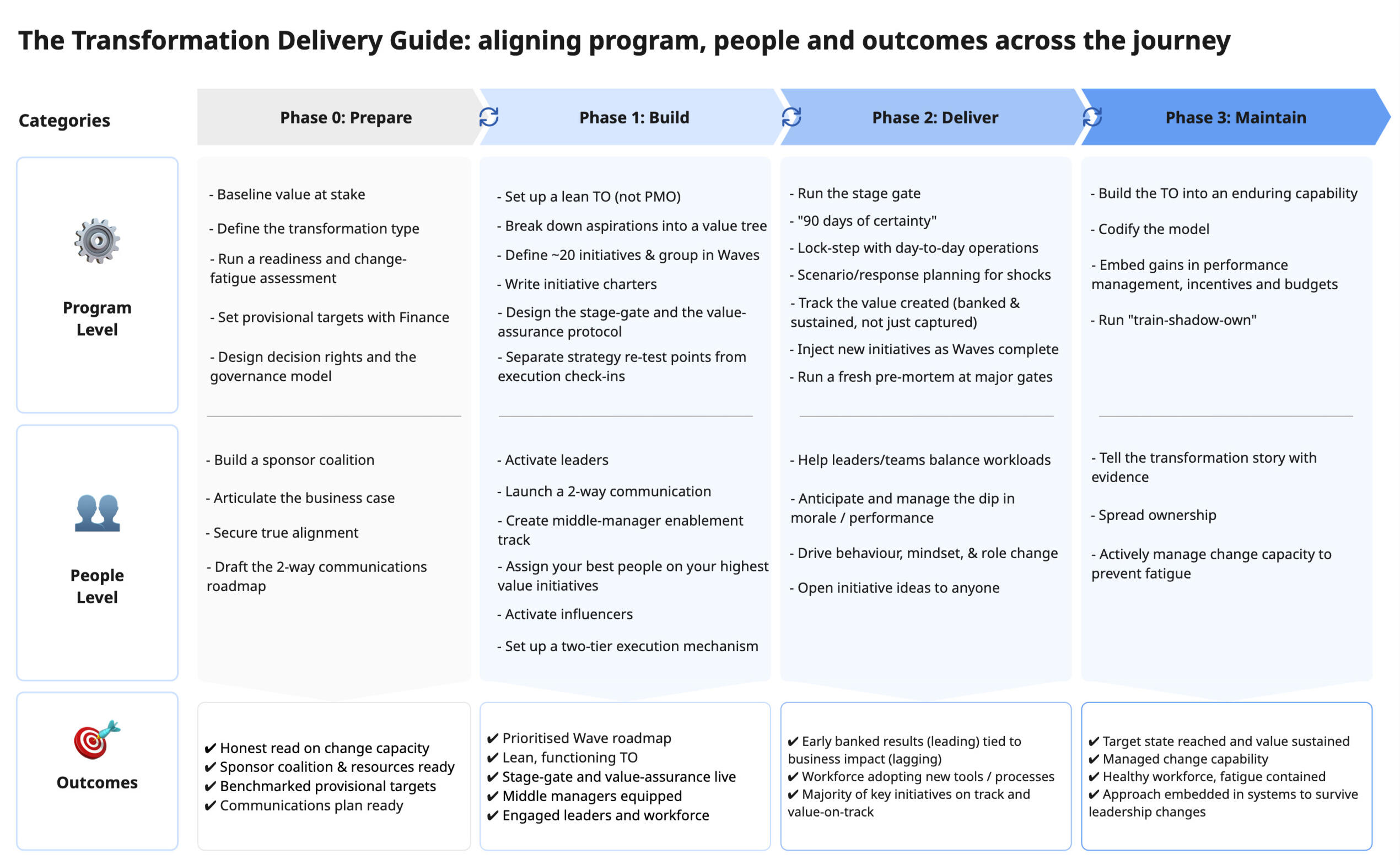
Exhibit 1: The Transformation Delivery Guide (by author)This guide presents a way to structure your thinking. Although it looks like a waterfall approach, the phases often overlap. Phase 2 may start while Phase 1 is still defining new initiatives. Likewise, Phase 3 of one transformation can overlap with Phase 1 of the next transformation, which becomes a recurring cycle.Let’s dive in.
Phase 0: Prepare (weeks 0–8)
This is where you chart the course and check your readiness before you start the transformation journey.–––At the Program level:Baseline the value at stake — assess where you are now and where your organisation can and should improve.Define the transformation type — a cultural transformation is different from a digital or operating-model transformation. The type decides the value that you want to capture and the metrics that you use to track progress.Run a readiness and change-fatigue assessment – Understand how much change the organisation can absorb and whether you have the capabilities in-house to do it.For example, some questions you might ask include:
Have we done this before? Has it been successful?
Do we have the capability and capacity to do it?
Are we experiencing change fatigue? (Have other transformations started and failed in the past? Is the workforce ready to go through another one?)
How big is the gap between the current state and the next state? (e.g. if it’s a significant jump, maybe scale it down and implement small first before you go big)
How urgent is the change? (e.g. is it time-bound, like having a date by which you need to sell the company, or is it competition-driven and ever-changing?)
How much capacity do our people have? (The workforce has day-to-day work targets to meet. Adding the transformation effort on top can lead to overload.)
Do we have a culture to “fail fast” that fosters transformation, or will we encounter headwinds on this front?
Set provisional targets with Finance — to ensure the transformation delivers financial results, above value-linked results, the change leader must engage the Finance department to (BCG 1):
Develop the baseline against which progress is measured — usually based on past performance, forecasted performance, and the likely financial gains, should the transformation deliver what it sets out to.
Agree the approach to track and validate progress — such as agreeing KPIs to track across all workstreams, the validation approach, and how to capture non-financial KPIs.
Define the tools to use to track expenses and new developments — including tracking actual vs planned achievements (monthly assessment), setting up system dashboards, and tracing and forecasting expenditure.
Design decision rights and the governance model — Who is authorised to make the decisions? For instance, the CEO usually makes the decisions on strategic direction and objectives and the CFO on financial goals. The Chief Transformation Officer (CTO) makes the decisions on scarce resources, coaching responsibility, and has the power to hold others accountable. Other execs usually have the power to make decisions within their own workstreams.Additionally, a best practice is to instil the boomeranging approach, whereby team members are empowered to approach senior decision-makers (e.g. steering committee) whenever they need to make decisions. This ensures decisions are made timely and the senior leadership is well-informed of developments. (BCG 1)–––At the People level:Build a sponsor coalition — engage the support of senior leaders in the strategic layer, often times C-level individuals. Ensure you have a coalition, rather than one individual, which withstands potential role changes, changes of priorities, and turnover.Articulate the business case — in a small leadership team, often consisting of answers to the questions (HBR):
Why are we changing our company? (the problem statement, how the transformation will benefit the company’s strategy, why it must happen now)
What are we changing about our company? And what are we not changing?
How will the changes occur? (across people, processes, technology, including the implementation and change management approach)
What is the investment required, and what value will it bring? (financial models, cost estimates, tangible and intangible benefits)
Secure true alignment — committed budget, people, accepted trade-offs. Beware of false alignment, whereby leaders agree quickly, but in reality, everyone has a different interpretation of how the change will be delivered. Have detailed conversations about “how” this transformation will proceed and the role of each senior leader in achieving it. Where this support is given at a great sacrifice from senior leaders, acknowledge that commitment with respect and appreciation. Here’s a full article on this: HBR.Draft the 2-way communications roadmap — make sure it is a two-way communication, where leaders ask for feedback from their workforce and bring them on the journey, rather than giving orders in a command-and-control fashion.–––Outcomes:
Honest read on change capacity
Sponsor coalition in place with committed resources
Ambitious, benchmarked provisional targets
Communications plan ready
Phase 1: Build (weeks 3–14)
At this stage, you are building the basis on which the transformation will rely, including the operating backbone and the behavioural shifts.–––Program:Set up a lean TO (not PMO) — a Transformation Office (TO) coordinates workstreams, timelines, and priorities. It is the single source of truth that ensures full visibility on progress, ownership and value delivered. (McKinsey 2) A TO can “improve value creation by up to 50%” and “free up business leaders to execute and deliver the goals of the endeavour.” (BCG 1) Importantly, it is not a PMO.In a TO, departments and team managers need to align on one pace and one place to track progress. They need to use the same processes, the same tools, and the same cadence for reporting and meetings. BCG introduces the 5 elements of a TO (BCG 1), which you can use to know what steps you can take to set it up:
Define the strategy and scope — namely, the steering committee, get sponsor buy-in, define their remit and their level of involvement in driving the transformation, set financial targets, define the transformation ambition, involve key departments, and make sure every stakeholder understands where they are going and how to get there.
Establish the governance structure — give them the decision rights, integrate TO into existing day-to-day processes and op system, their communication pathway to the finance department and other departments,
Set up roles within the TO — including the workstream liaison, communications, finance, HR, analytics, digital and tech roles and define the change delivery approach. TO employees must work across projects to see what they require. Help them balance transformation efforts (of oversight and implementation) with day-to-day work. (BCG 1)
Set up activities and processes — namely, working rhythms and routines. Change efforts can generate internal conflicts (such as status quo bias in individuals) as well as business-level conflicts (such as the business context conflicting with the desired behaviour you want to instil). Routines, such as weekly check-points, help teams surface blockers to change and find solutions or work-arounds.
Set up tools and data — to link initiatives to financial outcomes and impact assessments
Break down aspirations into a value tree and finalise targets — define initiatives that deliver a specific value (e.g. financial, technical, cultural, depending on the transformation type). Set SMART and ambitious targets. Studies show that when teams work in an environment that demands them to make progress every single day, this high-intensity work pace leads to a 5% to 15% higher success rate in transformations. (BCG 1)Define 20 initiatives max and group them into overlapping Waves — even global organisations can successfully focus only on around 20 initiatives in one program. (BCG 1) Once defined, group them into waves: Wave 1 (quick wins to gain momentum), Wave 2 (scale), Wave 3 (longer builds). Make sure to inject new initiatives as the initial ones are completed.Write initiative charters — including the owner, value logic linked to the baseline, milestones, start/finish dates, dependencies, risk/mitigation. Ensure they are approved by Finance and have their own leading indicators.Design the stage-gate and the value-assurance protocol — a methodology to keep the transformation effort on track, ensure outcomes are realistic, and fast-track delivery, as well as manage an ever-growing set of ideas that surface during implementation. More on this: BCG 1.Separate strategy re-test points from execution check-ins —this closes the common gap between strategic intent and operational reality. Just as the two execution layers were set up, namely the short-term layer focused on execution and the long-term layer focused on the strategic direction, establish regular check-ins per layer to touch base on progress and course correct if necessary.- Strategy re-test points — structured check-points to evaluate if initial hypotheses remain valid (e.g. quarterly business reviews, hypothesis validation gates, periodic SWOT scans)- Execution check-ins — recurring meetings that track progress on the ground (e.g. weekly/bi-weekly stand-ups, monthly business reviews, OKRs alignment meetings)–––People:Activate leaders — especially at the tactical and operational layers, communicate the case for change, reach true alignment, and give them the authority to execute that vision. In McKinsey’s research, among transformations that failed to engage line managers and frontline employees, only 3% reported success, versus 26% and 28% when each group was engaged. Management sets the direction, the organisation delivers the execution. (McKinsey 3)Launch 2-way communication — use both formal and informal communication channels to:
a) Communicate the single version of truth without relying on the senior leaders to trickle this information down to their teams, who do the same to their direct reports;
b) Create stories that champion the new behaviour that will circulate through informal channels like coffee chats. More on this: Jay Barney.
c) Make sure employees understand the “why”, the “what” and the “how”. Namely, the rationale, what needs to change, and how these will happen, including how this affects their day-to-day work, what they need to (de)prioritise, the skills and behaviours they need to adopt, and how their performance will be assessed. (BCG 2)
Create a middle-manager enablement track — this avoids the risk of the “frozen middle” where leadership messages get lost when they reach middle management, either because of resistance or confusion about the change to be enacted. The key is to shift them from “message carriers” into “change makers”.Best practices include: simplifying the role by reducing admin tasks, introducing micro-development conversations linked with the transformation objectives, or making transformation roles as career accelerators (McKinsey 3).Assign your best people to your highest value initiatives – Jim Collins had a great example in his book, which we can still find in the workplace today. He gives an account of a leader who had ambitions of expanding his company overseas, from its leading position in the US. Thus, he took his high-performing manager in charge of the US department and assigned him to the complete opposite side — international expansion. That team was the smallest one, and the opportunity was barely in its infancy.That ended up being one of the leaders’ best moves, since the high-performing manager grew the international presence of the company to extensive proportions and in good time.Activate influencers — gather them into influencer teams, train them with the new tools and behaviours, and let them become the champions for change that will inspire their peers. (McKinsey 5, PwC, EY)Set up a two-tier execution mechanism — that strikes a balance between detailed delivery excellence and keeping course to the desired goal (McKinsey 3):- Short-term for overseeing progress and team performance, ensuring delivery
- Long-term that keeps an eye on where the business is going and its ROI–––Outcomes:
Prioritised wave roadmap
Lean, functioning TO
Stage-gate and value-assurance live
Middle managers equipped (not just informed)
Engaged leaders and workforce
Phase 2: Deliver (months 3 — 20)
This is where transformation is underway, and the hard part begins.–––Program:Run the stage gate — ensure that the team meets every set period to assess progress and check whether the transformation is still geared into the right direction.“90 days of certainty” — Let the priorities be flexible during the stage gates, after that, lock them in and don’t change them until the next change gate. This gives people clarity and reduces confusion and running to reconcile different priorities (McKinsey 3)Lock-step with day-to-day operations — if transformations operate in a silo or are disconnected from the day-to-day operations, they risk ending up not delivering the desired outcome; competing for the same resources, leadership focus, and credit; and wasting time and effort overlapping tasks or reconciling priorities.This coordination needs an “operating backbone” to link the running and the changing of the business across 5 elements (McKinsey 4):1. Targets for the operating metrics (e.g. 5–7 tier one metrics)
2. Owners and accountability for these metrics
3. Defined time and effort necessary to make the improvements that achieve targets
4. The incentives linked to achieving the targets
5. Transparency to manage real-time performanceFor the in-depth decomposition of each one, refer to: McKinsey 4.Scenario/response planning for shocks — a mechanism to anticipate likely eventualities and craft responses accordingly. Therefore, if any of those scenarios happens, management can respond within hours, not days. (McKinsey 3)Track the value created – banked vs sustained, not just captured.
Captured value — realised value generated by implementing a new process, tech, or operating model. For example, launching a new digital platform reduced customer onboarding time by 50% and customer acquisition costs.
Banked value — locking in captured value so the benefit becomes visible on the financial statements and is not lost to the system. For example, lower customer acquisition costs and onboarding time enabled a reduction in the operating cost of the business.
Sustained value — ongoing retention of banked value, ensuring that the transformation benefits can be maintained indefinitely. For example, the new digital platform continues to onboard customers fast, and the company continues to benefit from lower operating costs 3 years after the transformation.
Inject new initiatives as the Waves complete — in the middle of the transformation effort, the dip can be concurrent with a dip in morale. On the program dimension, this dip can come in the form of results not showing on the P&L, a slowdown in transformation efforts or a sense that the teams are “stuck”. This tends to happen 6–12 months into a transformation, according to studies, but can vary on a case-by-case basis.In this case, the change leader should inject new initiatives into the transformation pipeline to keep the momentum going, ensure the processes and the energy of the workforce remain strong, or take corrective action if necessary. (BCG 1)Run a fresh pre-mortem at major gates — have a rigour check with all key stakeholders to expose critical flaws, such as an unassigned milestone or a dependency that wasn’t considered, as well as check that the goals of the transformation are still up to date with reality. (BCG 1)–––People:Help leaders/teams balance workloads — Adding the transformation effort on top of the workforce’s day-to-day responsibilities can lead to overload. People need the support to decide what work to re-prioritise, what to learn, how to behave in the new system, and how their career will evolve.Making transformation success a key determinant of performance reviews and budgeting is one incentive mechanism.Another approach to consider to minimise complexity is the helix organisational structure (McKinsey 1):- One leader to oversee the career progression of employees (esp within a transformation) and guide them through the transformation.
- Another leader to oversee progress and performance towards business and transformation objectives (keeps teams accountable for it)Additionally, a best practice is to “flip the pyramid” in transformations, where the senior leaders help solve the problems of the junior leaders and workforce. (BCG 1)Anticipate and manage the dip in morale/performance — know that in the middle of the transformation effort, there is a natural dip in morale, where negative emotions naturally spiral. Be sure to nurture employees’ emotions (make them positive rather than negative). (BCG 1, EY)Drive behaviour, mindset, and role change — shift mindsets to “fail fast” to enable teams to engage with the new ways of working and tools without the fear that this will negatively impact their performance reviews. (BCG 1) Model the behaviour that you are trying to instil, empower change champions, and develop incentives linked to the desired new system. (EY)Open initiative ideas to anyone — “To make change sustainable, ideas and operational drive need to come from the bottom up.” The people closest to the daily operations are best suited to identify practical improvements, take ownership of performance and embed new ways of working — an idea also promoted by Jana Werner and Phil Le-Brun in the Octopus Organisation.This is what happened in a success story, where a company was able to implement the transformation effort so well that new initiatives for improvement were coming from the tactical and operational layers of the organisation. (McKinsey 3)–––Outcomes:
Early banked results (leading) tied to business impact (lagging)
Workforce adopting new tools/processes
Majority of key initiatives on track and value-on-track
“Even in a well-run program, 20% of initiatives won’t achieve their desired impact, and even more (30%) will typically be at risk. If all of the initiatives in your tracking system are proceeding perfectly, you’re not aiming high enough.” (BCG 1)
Phase 3: Sustain (months 20+)
This is where you decide what will happen with the TO and the approach to transform. Making the TO a permanent capability enables organisations to adapt to perpetual changes and maintain their competitiveness.–––Program:Build the TO into an enduring capability — building an always-on transformation capability ensures that it keeps on steering the organisation through step-changes in a structured and rigorous way. This is different from continuous improvement, which deals with day-to-day improvements. (BCG 1)Codify the model — namely the processes and tools that made this transformation successful so that it can serve as a reference for future transformations (McKinsey 3)Embed gains in performance management, incentives and budgets — so they endure through leadership changesRun “train-shadow-own” – a central TO team leads the 1st wave, the business team shadows the 2nd wave, then they own the 3rd wave- The 1st wave proves that an org can execute its transformation
- The 2nd wave proves that it can keep doing it when the environment changes–––People:Tell the transformation story with evidence — celebrate small wins, publish achievements, and make role models visible.Spread ownership — the centre gives the impulse, the org carries it forward (it’s the self-organising teams principle of project management), but maintain oversight, steering (coaching), and expectations by using data to measure.“When transformation becomes how the business runs, no one needs to ask for permission to change. It’s already been built in.” (McKinsey 3)Actively manage change capacity to prevent fatigue — coming full circle to the very start of the transformation effort, this ensures that when the company needs to engage in another cycle of transformation, the team is ready to implement it, knows exactly how much they can push their workforce, and in what way.–––Outcomes:
Target state reached, and value sustained
Managed change capability
Healthy workforce, fatigue contained
Approach embedded in systems to survive leadership changes
CLOSING THOUGHT
Defining and delivering transformations are two different challenges.Yet both of them benefit from a structure that makes sense of the chaos, defines a plan to achieve the desired benefits, and brings people along on the journey.Delivering a business transformation is also about judgement – making the decision to course-correct where necessary, checking that the initial hypotheses are still true 1–2 years into the journey, and sense-checking where your team is at emotionally.Although transformation is becoming a modus operandi, its delivery needs to be tailored on a case-by-case basis.
🤔 Have you delivered or been part of a transformation?🤔 How did it go?🤔 What would you have done differently?💬 Let’s discuss.
If you found this article insightful, follow for more. I write on adaptive organisations, strategy, leadership, and decision-making in high-pressure environments.
From Temporary Transformation to Continuous Improvement: are we seeing a paradigm shift?
A Kaizen culture, an interview with a practitioner, and the rise of a new adaptive organisation13th August 20261% better every day — that’s Kaizen. “Disciplined people, engaging in disciplined thought, taking disciplined actions” (Jim Collins).In the corporate world, it’s not just the team member who goes the extra mile, who makes the product fixes without needing formal permission, or who flies to another city to serve a customer and comes back the next day acting like it’s just another Tuesday. It is turning these problems and ideas into small, disciplined, measurable improvements that become part of the standard way of working — that’s Kaizen.Kaizen is a Japanese word meaning continuous improvement, and it’s the combination of the words:- kai — which means change
- zen – which means goodIn management, Kaizen is a culture where everyone in the organisation is responsible and empowered to make improvements every day. It’s not limited to the actions of a factory floor worker or a client-facing associate, but also includes the actions of middle managers to improve how their teams deliver value, and the actions of top leadership teams to make strategic decisions on what the company should focus on next.
A. Kaizen in Business Transformations
A Kaizen culture can help organisations move away from a complex structure where several transformation streams run in parallel and are managed by a Transformation Office (TO), to a simpler structure where every leader and employee knows their role in navigating a shifting world without needing formal programs.Until that muscle of continuous improvement is built, the 7 Kaizen principles can be beneficial in business transformations:
1. Practice over tools
Consistent practice shapes behaviour, which in turn shapes culture, which determines whether new tools or processes are used or discarded after the transformation project is completed.This addresses a major challenge in business transformations — sustained results. Captured value is what you achieve at the end of a transformation project, but ensuring it converts into banked value (reflected on the balance sheet) and eventually into sustained value (maintained in the long run) is where it gets difficult.A culture that is coherent with the new tools and processes, which encourages people to change their behaviour and use the new system, ensures the transformation delivers sustained value.
2. Efficiency starts with flow
Flow is how quickly the company delivers value to its customers. This implies that resources don’t need to be fully utilised all the time. Fully utilised resources, people, and equipment may look like efficiency from a traditional perspective, but they can, in fact, constrict the flow of value.Think of a fully booked hospital. From a traditional viewpoint, the hospital is utilising all the treatment rooms and doctors to the maximum, hence you might be inclined to say it’s efficient. However, from a flow perspective, customers have to wait for weeks between the time they inquired to the time they receive a diagnosis or treatment.Value Stream Mapping is useful in analysing flow within organisations because it maps how value flows from the start of customer service to the end, and can help surface bottlenecks and areas of improvement. In our case, having done the Value Stream Mapping, the hospital may decide to free up resources, people, machinery and treatment rooms so that customers can get diagnoses and treatments in hours rather than weeks.Adopting flow efficiency can become a business transformation effort in itself. It requires rethinking what productivity means for the organisation, and rewiring the processes and remuneration systems to support this new definition. Such a transformation would be aimed at reducing time to value, improving customer experience, and minimising costs associated with waste or inefficient use of resources (more on the 7 types of waste here).
3. Small is not the only kind of Kaizen
Kaizen does not only apply to small improvements, like space optimisation on the factory floor (Daily Kaizen), but also to process improvements led by cross-functional teams and middle managers (Kaizen Events), and large-scale initiatives led by top leadership teams (Leader’s Kaizen).The idea is that if Kaizen is only limited to small improvements, adaptability is only reserved for the front-line workers. However, for an organisation to be fully adaptable to economic shocks, technological innovations, and changing social norms, Kaizen must be a practice for its managers and leaders as well, who have the power to steer it.In business transformations, this principle addresses the challenge of false alignment and employee confusion. False alignment happens when top leadership teams seem to agree on a transformation plan, but in reality their actions do not reflect this agreement.False alignment could happen for multiple reasons: either the implementation was not discussed in detail, which means everyone formed their own interpretation of what they should do; leaders feel under pressure to take action, so they postpone resolving disagreements to a later time that might not come; they are trying to protect their place in the old system, which means a transition plan was not co-created; or for other reasons. (HBR 1, 2026) As a result of the misalignment, leaders end up giving mixed messages to employees, leading to confusion and uncoordinated efforts.A culture where everyone is making incremental improvements from the smallest fixes to the biggest decisions, synchronised on a common strategy, mitigates the risk of misalignment and confusion in transformations.
4. Standardise to improve
Standards in a Kaizen culture are not rigid frameworks applied top-down that restrict free thought and autonomous decision-making across the teams. In a Kaizen culture, standards are the methods that work best, spread across the teams.These best methods could come from an associate who’s found the best way to do market analysis, or a manager who’s found the best way to lead without burning out their team, or a head of department who’s found the best way for their department to compete in the market.To create these standards, first identify the best ways to do a task, then train the teams on how to apply this method to the same task in a way that preserves the original learning while remaining flexible enough to be tailored or improved. This ensures that everyone in the organisation is working according to the best practices.When situations arise that favour revisiting the standard, take the opportunity to improve it and raise the bar for the entire organisation, who will then adopt the better method. Standards therefore make sure that the entire organisation is operating at the highest level of excellence known at any point in time. Any improvement by any one team member of any one process improves the standard and thus raises the whole excellence of the organisation with it.This principle can be applied both in managing business transformations, as well as a business transformation in itself.In managing business transformations, change leaders can identify the transformation initiatives that were most successful in the past, learn how they were done, and apply those lessons learned to the transformation program they want to implement.On the other hand, implementing best practices as a standard across the organisation can be a transformation project in itself. This would require the organisation to dig deep into its current processes, identify the best methods for doing each task (from market analysis to client communications and project delivery), standardising them across teams, and establishing a process to revise them when new information comes along.
5. Kaizen is more than operations
Kaizen at its core focuses on reducing waste, improving customer value, and solving problems in a structured way across the entire organisation, not in silos. For an organisation to build a continuous improvement muscle, all departments must apply a Kaizen culture. Kaizen is thus not only limited to the Operations teams, but should also be applied to Marketing, HR, Finance, and all other departments in a way that is tailored to their situation.Once a Kaizen culture is firmly in place, the company has the ability to adapt to new changes without needing formal change programs to be started and managed. Temporary transformation thus becomes continuous improvement.
6. Kaizen is a strategy
Kaizen is a strategy for improvement that is executed and defined by all levels of the hierarchy through dialogue and collaboration.The challenge most transformations face is the lack of follow-through. Leaders announce the change, as per Kotter’s 8 steps, and then wonder why nothing happened 6 months down the line. This is a classic example of strategy being defined by the top management team and then applied top-down with little room for feedback or co-creation from the organisation they are leading.In a Kaizen culture, strategy is defined in collaboration with the organisation and is lived by every team member every day. The leaders communicate with teams to understand how customer value is delivered, the pain points, and the necessary adjustments. Based on this dialogue, leaders define the strategic objectives together.Once these are clear, the leaders make sure that every employee, from senior managers to junior associates, knows their role in achieving these objectives and follows a system that ensures a Kaizen culture is maintained (such as Kaizen Events or Hoshin Kanri planning for top leadership).In this sense, Kaizen is a strategy that makes sure the organisation has a smart system in place that ensures:- Decisions reflect the realities of front-line workers and customers
- The culture of continuous improvement is sustained regardless of the strategic direction, through daily routines and standards
- The strategy follows a short cycle of launch and adjust, so that it adjusts and adapts to ad hoc changes in the marketAdopting Kaizen as a strategy in business transformations means that leaders don’t start with a big announcement of change to create energy. Instead, they create the system that will inform their transformation direction, and only then define the transformation, implement it, and sustain it.
7. Kaizen is the smartest way to run a business
Traditional management theory assumes that applying frameworks to deliver customer value is the best method to ensure structured decision-making. Kaizen, on the other hand, offers a simpler way of managing an organisation, namely a system that is dynamic and informed by the realities of its employees and customers.In business transformation, this is the leap from having several transformation programs run by a TO to building the capability to adapt without the need for formal programs.
B. Interview with a practitioner: how does Kaizen work in practice?
Borja Blanco Méndez has been a consultant for Kaizen Institute in Western Europe, where he’s helped clients adopt the culture of continuous improvement. There are two kinds of projects in general: a) culture change and b) operational improvements.A prominent example from his experience is the culture change project with Sonae. Sonae is a multinational group headquartered in Portugal that manages a diversified portfolio of businesses in real estate, retail, financial services, technology, and telecommunications.Sonae had a phased adoption of the Kaizen culture. To start with, Sonae had an existing relationship with Kaizen Institute in Portugal that helped train its leadership team in the principles and application of Kaizen. As a result, leaders were trained to use the Kaizen methodologies to help them understand where their company was being wasteful and what processes they could improve.This led Sonae to decide to expand these Kaizen practices to its retail real estate business in Spain. This is where they requested the services of Borja’s team from the Kaizen Institute in Spain to help them implement a culture change of continuous improvement not just for their teams but also for their contractors, such as security, cleaning or gardening contractors.In practice, this meant that Borja and his team had to not only coach people from very diverse backgrounds, from shop-floor guards and cleaners to team leaders, to adopt a Kaizen culture, but also to involve them in the design process to secure their commitment and instil a sense of ownership.For front-line workers, the training had to be clear, practical and actionable, teaching them the foundations that will be subsequently implemented in their day-to-day work. For team leaders, the workshops were in the style of “train the trainer” so that leaders could apply these practices autonomously in the future.Borja and his team started with a bottom-up approach, namely with the front-line workers. They applied 4 phases, with appropriate stage gates in place at the end of each level. Each phase would only start once the objectives of the previous stage-gate were met. The 4 phases were:
Organise time — implement daily routines for front-line teams (Daily Kaizen) and focused improvement workshops for team leaders (Kaizen Events). Coach them on how to run those meetings, let them implement them, and then audit at regular intervals to make sure the Kaizen standard is sustained. The stage gate is a light-touch audit, where Borja would join the meetings and check that they were done according to the Kaizen best practices. If the expectations were met, the team would progress to the next level.
Organise spaces — in line with the Japanese methodology of 5S (sort, set in order, shine, standardise, sustain) to ensure the shopping mall floor was well organised. This implies sorting what is needed from what is wasteful, arranging what is needed in an orderly fashion, keeping them polished and clean, putting them in their place, and maintaining this discipline. An example was to optimise inventory spaces, which led to cost savings due to better management of supplies and workers’ time, as well as to improved cash flow due to the leasing of unused storage spaces to stores. The stage gate was also a light-touch audit, which if passed, would move the team to the next level.
Standardise processes — involves finding the best way of doing tasks and standardising it across the teams. In practice, this involves taking a Gemba walk (such as a walk through the shopping mall at 5 a.m. in the morning to see how it’s being opened), mapping the processes, identifying the most repetitive key tasks per team and identifying quick wins within those tasks. This includes eliminating the 7 types of waste (or Muda): waiting, defects, inventory, overproduction, overprocessing, transportation, motion. The key is to make visual representations of the processes so that anyone can understand them.
Improve processes — incorporate process improvement methodologies, such as the 5 Whys, Process Mapping, SDCA / PDCA (Standardise / Plan –> Do –> Check –> Act), and others to ensure the process of improvement is self-sustaining. This process continues even after the coaching engagement is finished. Self-certification and self-evaluation are highly encouraged across the hierarchy to maintain the Kaizen best practices within the company.
After the engagement, Sonae had built their own team of Kaizen specialists, the IOW School, which to this day continues to audit the company every year to make sure their Kaizen culture is maintained to the highest standards, as well as to teach the principles of continuous improvement to the whole Sonae group.The immediate result from the project yielded six-figure annual savings that paid back the engagement within the first year due to optimised storage space that unlocked more space to be rented to stores.The long-term result was a sustained Kaizen culture for over 10 years and counting. Moreover, in the last 10 years:- Sonae’s turnover increased by 127% from €5.014bn in 2015 to €11.4bn in 2025, with a CAGR of 8.6%.
- Meanwhile, its underlying EBITDA increased by 276% from €299m in 2015 to €1.123bn in 2025, with a CAGR of 14.2%.Whilst these increases were likely caused by a combination of factors, such as acquisitions, digitalisation efforts, or reporting changes over the past 10 years, one fact is worth noting.- Sonae’s underlying EBITDA grew 1.65x faster than its turnover in the last 10 yearsThis indicates that Sonae most likely benefited from improved productivity, higher margins, growing scale and better cost control. All of these are benefits of a Kaizen culture. Whilst it’s impossible to separate the effects of Kaizen from other causes that led to this growth, it is very plausible that Kaizen had a significant impact on Sonae’s growth.
C. Why Kaizen - now more than ever?
Business transformations have traditionally been:- Regarded as having a defined start and finish date
- Deployed as one-off projects: kicked-off when the company needed to make a change, ran and tracked as a project, concluded once the deliverables have been achieved or the time allocated has elapsed, and re-started once the need for change comes back
- The sustained value from change is difficult to attain since the company is at risk of sliding back to its original ways after the transformation project concludedThis way of thinking was better suited to a world that had a predictable pace of change, high customer loyalty, well-defined industry boundaries and highly defensible competitive advantage based on tangible assets (e.g. plants, machines, land).Today’s world is different. A rapid pace of change, blurring industry boundaries, and intangible assets becoming the new source of competitive advantage (e.g. IP, human capital, AI patents, co-innovation) are all new forces that require new approaches.In today’s world, adaptable organisations are the ones that can “alter when (they) alteration find”, that can adapt to change with integrity and intelligence, that have cultivated continuous improvement as part of who they are. Kaizen is one such form of ingrained adaptability.
D. Are we seeing the rise of a New Adaptive Organisation?
In the traditional sense, such as Kotter’s 8 steps, leaders sweep in with announcements of big transformations. This creates enthusiasm that imbues the organisation with the energy it needs to make the shift. However, it can also create resistance, confusion, miscommunication, misalignment between top leaders on what exactly needs to be achieved and how, and change fatigue (where employees are skeptical about the announced change since they’ve heard 10 other announcements like that one in the past 2 years without any significant result).However, here’s another truth. In the study of the companies that outperformed the market for more than 20 consecutive years, leaders transformed without announcing it. They made the decision about where their company is best positioned to create value and got to work to push the flywheel.They didn’t invest in motivating people to tag along, because results spoke for themselves. Small wins at the start got the attention of the employees, suddenly a rush of excitement was felt and some joined to push the flywheel, which generated bigger wins which in turn motivated even more people to join in to push the wheel. They were striving towards a goal they were all passionate about and saw that pursuing that path brought successes.In the past, transformations weren’t sold as a project to be completed or as a transformation-as-a-service, rather they were the way a company operated.It is true the pace of change is now much faster and the world is much more different, but the same truth emerges. To stay competitive, companies they need to be adaptable. Adaptability needs to be part of their organisation, a muscle they can use to re-direct their company as new change and new technologies come along. This capability is continuous improvement.The principles of Kaizen overlap with the concept of the Octopus Organisation, the success factors of the Good to Great companies, the concept of strategic centring, and the requirements of modern leadership.Let’s take it step by step.The Octopus Organisation states that nowadays, companies must rethink their playbook for change. Change is no longer a rigid framework to use, but rather a set of principles to follow, such as distributing decision-making and autonomy across the organisation to the people who are closest to the problems and have the best understanding of the solutions to solve them. These autonomous teams are aligned with the vision and steering of the central leadership team that makes strategic decisions about the company’s direction.Kaizen, as we have seen, is a management system that encourages workers to take ownership of their areas of influence and make continuous improvements every day. Kaizen, therefore, can support the functioning of an Octopus Organisation, like the blood system of the octopus.Strategic centring means that companies focus not so much on the purpose of the organisation, but on who they are at the core. This is similar to the Hedgehog Concept in Good to Great. For example, when deciding between investing in a safe bet (to expand its commercial pharmaceutical branches) or charting a new course (investing in R&D that pushes the envelope on patient treatments), the leader must look at their strategic centre. For Novartis, in this case, they were a company that innovated and found new ways to treat its patients at the core. Knowing this, the leader decided to invest in R&D, which would seem like a risky investment to the external spectator. Because this decision aligned with the core, Novartis ended up becoming the leader in innovative treatments and divesting its commercial branch. This can then be the heart of the octopus. (HBR 2, 2026)The requirements of modern leadership are changing as well. A recent study found that leaders in leading companies like Nvidia were not, in fact, servant leaders who got the right people on the bus and got out of their way. Instead, these were leaders who were actively present in the day-to-day lives of their teams (a principle that Kaizen also advocates for). In companies like Nvidia, the leaders were actively collaborating with their teams of engineers to solve challenges and test innovations. (HBR 3, 2026)Bringing all of these emerging facts together, it looks like we might be seeing a paradigm shift. The rise of a new adaptive organisation that:
Is structured as an octopus organisation — delegates decision rights and autonomy for people to make improvements alongside the strategic core, and enables frequent 2-way communication.
Uses Kaizen as their management system — makes sure that the dedication to improvements continues tomorrow and the next day, without a final target to reach.
Follows strategic centring for decision-making — sets the direction for your company and starts pushing the flywheel to generate small wins, share early successes with the organisation, and embody the example of what the organisation should be.
Promotes active leadership across its hierarchy — enables leaders to have a proactive involvement with their teams and be aware of the realities of front-line workers and customers.
In this type of organisation, transformation is no longer a set of programs, but a “way of working” that stands the test of time and change.
CLOSING THOUGHT
What if transformation in this fast-paced age is not about rolling out one change program after the other, but instead it’s about building that system that will carry you through any change because its people have been trained to handle change?For the era of stability and tangible assets, the old systems were a good fit. For a new era of accelerating change and intangible assets, a new system must take its place.
If you found this article insightful, follow for more. I write on adaptive organisations, strategy, leadership, and decision-making in high-pressure environments.
Are you ready for a world of constant change?
26 practical tips for navigating change in an era where business transformation is the new normal27th August 2026
AUTHOR’S NOTE: This is not a typical article where I tell, and you read. This is an interactive exercise where I invite your collaboration on:–> How do you, as a leader or team member, approach change on the ground?Comment, challenge, add, amend, critique or share a true story. This is my invitation for you to join a discussion. Everyone’s welcome.
It’s easy to take an eagle’s-eye view and say: “This is what you need to do to change.” Implementing it on the ground, however, is a different story.Imagine you’re sailing the ocean with a couple of friends. Everyone on board knows with intellectual clarity: their destination, how to navigate, how to steer and manage the ship, and how to act, communicate, and pivot when a storm hits.Yet when the storm hits, all rational clarity is thrown overboard. Pulling the ropes in salty water is harder than it seemed; shouting over the crashing waves suddenly doesn’t work as planned; teamwork breaks as people short-circuit under pressure or forget the order of steps; if a sail comes undone, anxiety settles and fire-fighting begins. Suddenly, the mindsets that you thought would work are harder to adopt under pressure than expected. Emotions, although perfectly understood, are much harder to control when you are feeling them.That’s what tends to happen in a change effort. That’s the difference between:1. Knowing how to change — creating change roadmaps, establishing communication plans, setting progress trackers, planning trainings;2. Doing it “on-the-ground” — having the tough conversations, handling the pushback and emotional reactions, balancing competing priorities, untangling confusing messages from your managers, fighting self-doubt while coaching the team, and overcoming the urge to go back to the old ways just to avoid the uncomfortable pressures of change.The first point is often discussed to a great extent. The second point is less highlighted, but it’s the one that makes or breaks the continuous change capability that you are trying to instil.For continuous change to become a constant capability, people need to be comfortable with change. In other words, become comfortable with navigating storms as if it’s just another Tuesday.This applies not just to leaders, but also to team members. Success in bringing about the desired change for the organisations, as well as in their career, means that they need to have the capacity to perpetually change how they work, lead, think, behave, and approach uncertainty:- For leaders, they need to know how they should lead and coach their teams not just in week 1 of change, but also 1–2 years down the line; the winning traits and behaviours; the playbook they can use in meetings or day-to-day life; the mindset they need for themselves and others; the teams they need to assemble; and how they should coach and guide them.
- For team members, it’s not just about blindly following the leader either, especially nowadays. Team members need to have the qualities, the mindsets, and the independence to know how to navigate continuous change, when to take initiative, how to solve problems ad hoc when no leader is available, and how to hold themselves responsible for their outcomes while maintaining trust and reliability in the eyes of their managers.The team members’ side is commonly overlooked, but it’s the one we must address with the same level of dedication as we address the leaders’.My question to you is:–> How do you prepare for constant change in your professional environment?Let me know in the comments.
LET'S GET STARTED
Think about how you stay ready for constant change, whether you use any of the tips from the list below, what’s missing, and which one is the most useful for you.Let’s add some structure to our thinking and classify the “readiness requirements” into 4 dimensions: mindsets, behaviours, tools, and environment. Strengthening each dimension is key to navigating constant change without disaster.
1. Mindsets
Deliberate calm — observe your external environment as well as your thoughts and feelings. In a tense moment, name what you’re feeling before you act (e.g. “I’m defensive right now”). This mitigates the “adaptability paradox,” where leaders default to the old ways that they know best during unfamiliar, high-stakes moments, when adaptability and creativity is needed most.
Resilient mindsets — learn from setbacks rather than being discouraged by them, see change as an opportunity to grow rather than a threat to fight against, and develop a discipline of treating every experience as learning.
Above-the-line thinking — make a constant exercise to stay above-the-line. This is characterised by creativity, freedom to experiment, psychological safety, and curiosity. It is easy to slip below-the-line, which is characterised by defensiveness, a survivorship mentality, and assumptions that people are out to sabotage you.
Always-on learning — be curious and open to being wrong, as well as open to being corrected and coached. Feedback is useful from the top (more senior colleagues) as well as from the bottom (junior colleagues). This is essential in exploring new methods and adapting quickly in ambiguous situations.
Accept uncertainty — change your approach as conditions change and accept the fact that you’ll never have 100% clarity or information to make a decision. Take the best course of action that can be taken given the information you can obtain. Change means operating in uncertainty.
Small wins before big leaps — steady progress over a period of time beats swift, short-lived acts of grandeur every time. Celebrate the small wins and hold them as proof that the flywheel is slowly turning in the right direction. It’s also a powerful motivator for people to join in and push the flywheel further, which in turn generates more wins and creates a positive spiral.
Cultivate grit — be adamant on your destination, but flexible on how you get there. This is about persisting in adverse circumstances or when the going gets tough. More on this from Dr Angela Duckworth.
Identity shift — identity determines how we think, act, and make decisions. If you hold the identity that you’re someone who doesn’t back down from their position, you’ll find yourself struggling to accept the need for change. The opposite is also true: if you believe you’re a problem solver and a person who makes change work to your advantage, you’ll likely find it easier to adapt to new circumstances.
Balance optimism with prudence — be open to new ideas and driven to achieve your goal, but make sure you always understand the full risk and complexity of current circumstances. Changing course as new evidence comes in, without abandoning the destination, is an example of prudent optimism.
Keep your eye on the North Star — remind yourself of the desired transformed state whenever you face a difficult decision or conversation, such as by making it highly visual, real, and unforgettable for yourself and others. More on this at HBR 1.
2. Behaviour
Ask for feedback, and act on it — you cannot always know how you come across to others, whether you have unconscious bias, or if your communication style fits expectations. As roles and expectations shift during organisational change, so too should behaviour. The best way is to be proactively coachable.
Overcommunicate — during change, it’s easy for information to get lost, miscommunicated, or misinterpreted, especially as it travels from ear to ear. Undercommunication leads to confusion, wrong prioritisation, and time and resources allocated to incongruent tasks.
Clarify the challenge/support ratio — when leading change projects or executing tasks, make sure that you can do 80% of the task and are challenged by the remaining 20%. This is the margin of productive growth. Too much comfort, and you’re not developing yourself or your team enough; too much challenge, and you are setting yourself or your team up for an uphill struggle that you might not win.
Protect your R&Rs — set boundaries, protect your off-hours, prioritise the basics that keep you alive and focused, such as sleep, healthy food, exercise, friendly banter. It’s a strategy to maintain peak performance for longer and avoid burnout.
Have a sense of humour — humour lets the other person breathe and diffuses tensions. It lets everyone know that “while the stakes are high, they’re not the whole of life” (Ron Carucci), which in turn enables teams to persevere for longer in high-pressure environments.
Have empathy, especially for mistakes — change means you constantly move from known territory into the unknown. As such, in order for you to find the best ways to operate in the new territory, mistakes, healthy risk-taking, and benign rule-breaking are natural occurrences of adaptation. Whenever you have a difficult conversation about resistance to change, mistakes using the new system, or benign rule-breaking, first understand it’s natural, and second have the empathy to ask for details without judgement. More about this at: HBR.
Be curious, especially in resistance — Resistance is information. When someone says: “This will never work,” this is an opportunity for you to find out what is not working, what is holding this person or their team back, what is it that you don’t know (perhaps a change initiative that had gone bad in the past, or that change fatigue is setting in). Start by asking, “Why would you say that?”, and dig deep. Then, “How could we make this better?” which not only invites collaboration and ownership, but also surfaces solutions that only the people closest to the problem can bring. Lastly, “Is there anything I can do to help?” invites them to show you the obstacles they are facing, such as a legacy process or competing priorities that don’t allow them to change, and gives you the chance to help remove them.
3. Tools
Communication tools — it might sound too easy. Yet, the amount of effort and time that teams and leaders lose to poor communication is significant. Coffee chats in the morning, team touch-base sessions, informal 1:1 for remote workers, and everything in between ensure that teams are heard, supported, and coached to move towards the future state in a smooth and orderly fashion.
Shared spaces — even in today’s remote-working world, most of us can attest to feeling reassured when we have colleagues or strangers working beside us. It’s a sense of shared purpose that we seek: whether you’re in a company office solving problems together, in a co-working space building your dream company, or in a coffee shop studying with your peers to land your dream career. When the world is in motion, having a physical place to ground you in the here and now is essential.
Coaching culture and open feedback — an organisational coaching culture ensures that leaders are equipped to coach their teams through the ups and downs of change and that you bring your people with you on the journey. For teams, this means everyone is supported and given the chance to develop together with the organisation. More on this here.
Wellbeing routines — the quality of your rest every night determines the quality of your results every day. When change is everywhere in the workplace, having routines can give you a constant to return to. It could be hitting the gym on Saturday mornings to start your weekend fresh, walking the dog in the evenings to disconnect from work, or taking cold plunges to reset your nervous system. This may sound trivial, but they are the small steps that compound into big results with consistency.
Lifestyle apps — a 2-minute guided breathwork to energise you before a high-stakes meeting, a mindfulness break during your lunch walk, or a health-tracking app that rewards you for movement at the end of the day. If your working life is constantly changing, micro-breaks are moments of peace that will keep you resilient in the long-term.
4. Environment
Sponsor network — change leaders don’t just need a mandate. They also need the sponsor mechanism to set them up for success. For leaders, this means ensuring you have the resources, the buy-in, the decision-makers that can help you resolve deadlocks, secure resources, and help you out when you need it. For team members, this means that you not only have a mentor, but a sponsor that can put your name up for new challenges that will help you grow. Change means you either lead it, or you’re a part of it, but in either scenario, you need a sponsor network to be successful.
Support network — have at least 3 people that can a) hold you accountable for the goals you want to achieve, and b) offer guidance, a listening ear, or reassurance when you are overwhelmed by how fast things are changing. The power of your support network determines how far you can go and how well you can lead change without backtracking. More on the power of the 3x3x3 approach at McKinsey.
Communities — find where you belong both at work and in the off-hours. For leaders, this could be a network of peers or senior leadership that can offer honest feedback and alternative viewpoints, which enriches the way you look at and approach challenges. For team members, this could be your work cohort with whom you exchange ideas about tackling specific tasks or conversations, or it could be industry expert groups where you learn and specialise among other experts. Outside of work, maybe you take up Toastmasters to meet people passionate about public speaking, or join a run club to stay active, or perhaps join a hiking tour to see places that take your breath away. Having a sense of belonging tells you that you are not alone. This makes you more resilient in navigating changes and setbacks.
Break from routine every once in a while — routines for micro-tasks, such as sleeping and grocery shopping, are a good way to offload your mental capacity to more challenging tasks. However, breaking the routine once in a while, like travelling to a new country or suburb, trying a new hobby, or adopting a pet, is a great way to create new neural connections and become comfortable with change. In those moments of novelty, you start to associate change with feelings of excitement and joy. You can bring this attitude to change to the workplace, which will help you navigate it better. Sure, it’s scary to climb a mountain, but the views at the top are spectacular. That’s the excitement that comes with embracing change.
CLOSING THOUGHT
It’s one thing to create elaborate plans and to intellectually conceive of all the bits and bobs of change over a cup of tea in your favourite library with a wall of blueprints.What it’s like in the middle of change, and what most employees are feeling, is another thing entirely, and one that they are often left to navigate by themselves.If articles exist to help leaders self-study, fewer articles exist for associates who are just starting on a career path that’s experiencing an unprecedented level of volatility and uncertainty, but which they must navigate with comparatively less support, less coaching, and less self-help materials.Hope this helps level the playing field to some extent.–> If you’re a young professional navigating change, how are you getting on, and what do you think needs to change?
–> If you’re a business leader, how do you usually navigate change, and do you have any tips, highlights, or challenges?Comment at the link below.
If you found this article insightful, follow for more. I write on adaptive organisations, strategy, leadership, and decision-making in high-pressure environments.